Tag Archives: Politics

The Council’s (Tax) Dilemma

If other parts of England are pursuing similar ambitions as Exeter City Council then proposals for reorganising local government risk being derailed once people understand the council tax implications.

The government’s Christmas present to the nation was to embark on reorganising local government in England. According to the White Paper, the aim is to deliver “a generational project of determined devolution”. A key element, justified by an apparent need to streamline the structure of local government, is the ambition for “two tier” structures to disappear. So the remaining county and district councils are to be reformed into single tier unitary authorities.

Devon County Council is one such two-tiered area, and all councils – including the existing unitary authorities of Plymouth and Torbay – have been asked to send the government final proposals for restructuring by 28 November. The chances of them all agreeing on a single way forward are somewhere between negligible and nil.

Exeter City Council is advocating a unitary authority centred on Exeter but incorporating some of the surrounding parishes – 49 on their list [Note 1] – currently in other district council areas. Here’s the list.

A meeting of the City Council on 14 August approved unanimously this geographical plan as the basis for further work. Apart from technical issues, such as finance, there would be consultations with the residents of the 49 areas that would find themselves as part of a Greater Exeter unitary.

Now there’s a lot of sense behind the proposal and anyone interested should read the minutes and paper for the August meeting. But there is a looming problem arising from the existence of parish and town councils among the 49 areas [Note 2]. No such councils exist in the city of Exeter.

What are parish and town councils?

To start by correcting a common misapprehension – they represent civil administrative parishes amd are nothing to do with the parishes of the Church of England. Originally established under powers in the Local Government Act 1894, many have developed to the point where they are responsible for significant local services. This is particularly true of those parish councils which have resolved to call themselves Town Councils: these are Budleigh Salterton, Chudleigh, Cranbrook, Crediton, Dawlish and Exmouth.

Parish councils vary widely in the services they provide: see box.
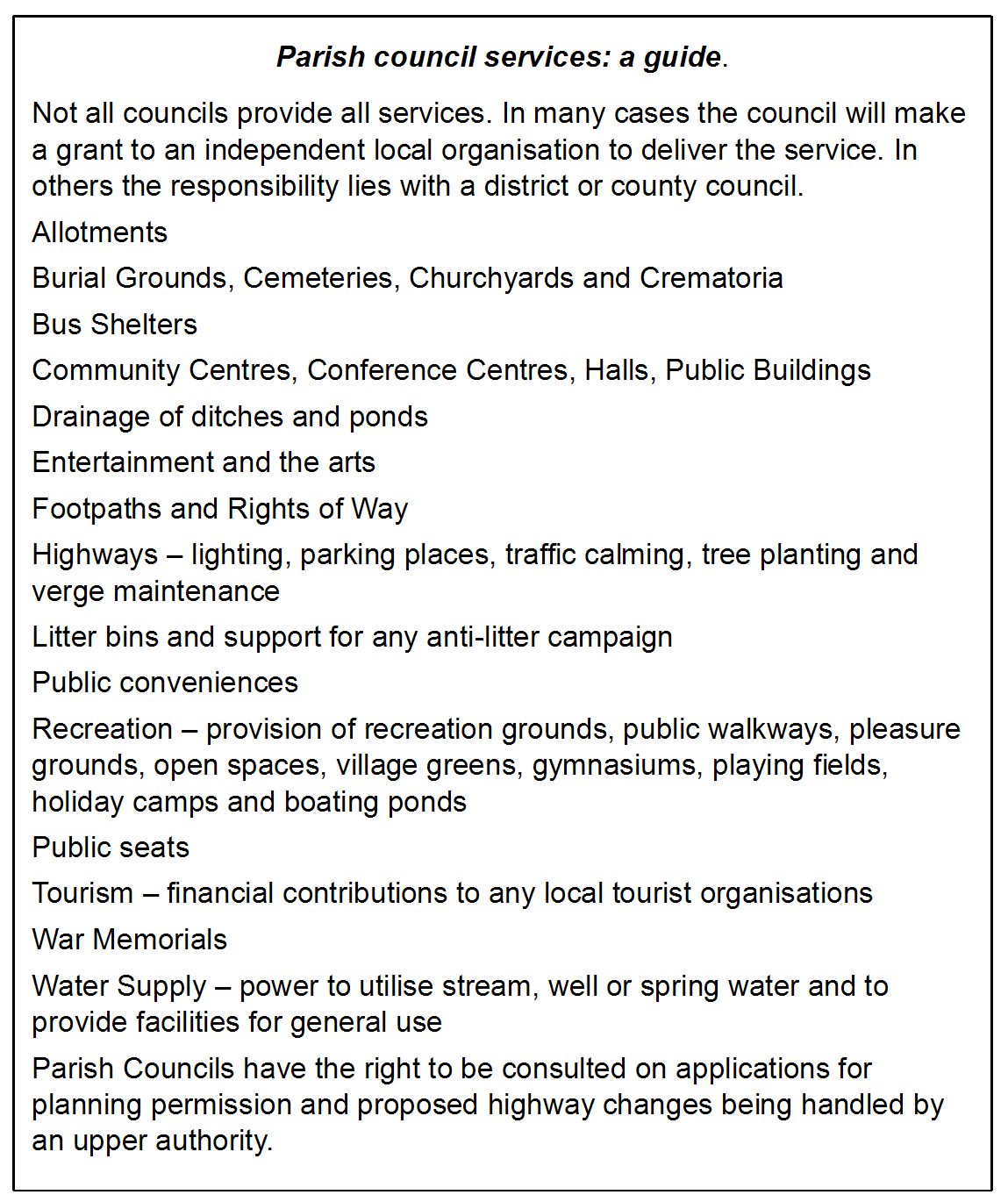
It follows that the amounts they charge their residents – the council tax precept – vary widely. Among the 49, the highest and lowest precepts for 2024/25 (excluding Cranbrook, an outlier with a precept of £256.03, and those parishes with a nil precept) were:

CouncilHighest PreceptsCouncilLowest Precepts
Crediton£174.08Whitestone£19.04
Broadclyst£156.22Crediton Hamlets£19.02
Clyst Honiton£144.74Mamhead£8.94

This all gives rise to a serious equity issue inherent in the Exeter proposal, and it centres on council tax. I will try and explain it very simply.

Your council tax bill is made-up of a number of elements, specifically charges levied by different authorities as payment for the services they provide. Bills are sent out by district or unitary councils, so in present case Exeter City Council sends out bills to its residents covering not only payment for the services it provides but also charges (“precepts”) from Devon County Council, the Devon and Cornwall Police and Crime Commissioner and the Devon and Somerset Fire and Rescue Authority. Added together these precepts are transformed into a council tax rate payable according to the banding of your property [Note 3].

Where parish councils exist – as is the case in all the other Devon district council areas – parish council precepts are also added to the council tax bill.

Among the 49, the range of precepts is shown in the table above. Where services are provided by a parish council there is no accordingly no requirement for the district council to provide them and this will feed through into a proportionate reduction in the amount of council tax levied by the district council.

As there are no parish councils in Exeter, the City council provides all these services itself, paid for through the City Council element of the council tax. In the absence of parish councils a new unitary authority will have to provide these services direct in Exeter. It seems highly unlikely that the 49 – particularly the town councils – will be prepared to hand over the running of their local serices to the unitary authority and so they will continue to charge their residents through the parish council precept. It follows that these residents will end up paying twice – once through their own parish council precept and again to the unitary authority for services delivered in Exeter.

What to do?

One approach would be to create a separate town council for Exeter so putting it on the par with the 49. This would enable the unitary council to reduce its own council tax spend by transferring relevant responsibilities and the associated expenditure to the new town council. but it would fly in the face of one of the key aims of the reforms which is a single tier of local government. There are ample precedents for this: on creation of the Somerset unitary council in 2023 its county town, Taunton, established a town council. 5 years before that following the creation of a unitary council for County Durham, the City of Durham district council was replaced by the oddly though accurately named City of Durham Parish Council.

However, the present government has said that it does not want to see any new parish councils created, but then as I’ve observed in the past they do seem to be making this up as they go along.

An alternative would be for all the town and parish councils in the 49 to be abolished with the unitary taking on financial responsibility for the services they currently provide. Local representation on the decision making would then be provided through the government’s favoured neighbourhood area committees but as creatures of the unitary these would have much less clout. Such a move would also have the 49 up in arms against the proposals as well.

The third option is to leave the parish in town councils in place and to address the financial iniquity by modifying the unitary authority council tax in each locality to reflect the payments made by residents to the town or parish council. I’m no expert but I’m pretty sure this would require a substantial rewriting of the current council tax legislation, and it would be a bit of an administrative nightmare.

Rocks and hard places come to mind.

Notes

[1] The Exeter proposal lists parishes, not parish councils. Bicton parish is administered as part of East Budleigh parish council, while the parishes of Clyst St Mary and Sowton now come under a single parish council called Bishop’s Clyst. In addition, 6 very small parishes do not have a parish council but are administered through a Parish Meeting. So there are only 41 actual councils.

[2] I use the term “parish council” to include town councils which have the same legal status.

[3] All council tax figures quoted are for Band D properties.

Wanted: discipline in government affairs

The Labour government is understandably in a hurry but risks making a profound mess of local government and diverting effort from its new homes target.

A long. long time ago, when I was a civil servant, project and programme management was all the rage. Perhaps it still is, despite the bad press it got after the service allowed management consultants to set up numberless programme offices everywhere whose principal output was to demand “progress” reports from the people doing the work and to regurgitate these in full colour to programme boards. Personally I avoided them, particularly after a consultant appeared in my office to tell me that I couldn’t have my programme manager on my programme board because it was against PRINCE 2 rules. After being abruptly directed to my door, he was never seen again on my patch.

None of this is to suggest that I don’t see a role for well-conceived programmes and projects: on the contrary, one of my final roles in the civil service was as a reviewer in the now-departed Office of Government Commerce, an agency of HM Treasury. Small teams of us would descend on high-risk programmes and projects to find out whether they were being run properly. Highly enjoyable.

Which brings me to the present day. What is going on in the local government directorate of the Ministry of Housing, Communities and Local Government (MHCLG) makes one wonder whether they’ve abandoned programme management (perhaps due to a surfeit of consultants?) or whether it never took root in the Ministry in the first place. Or perhaps its practitioners just don’t know how do it

However you look at it, local government in England has been overwhelmed by a series of MHCLG initiatives which purport to add up to a coherent whole, but – at least viewed from the coal face – do nothing of the sort.

For those readers wishing to look at a detailed study of the mayhem, the Exeter Observer team have produced an excellent deep-dive analysis of what is happening in Devon: read it here.

Currently the only public aims and objectives statement that I can find for the MHCLG is on the gov.uk website:

Setting aside the unfortunate image of senior civil servants in hard hats and boots digging in the mud, the statement encapsulates three distinct actual work streams:

  • increasing the number of homes, with a target of 370,000 each year
  • devolution, under which powers are to be devolved from Whitehall to local authorities and elected mayors
  • local government reorganisation, seen from Whitehall – though possibly from nowhere else apart from public-sector-hating think tanks – as an essential pre-condition for achieving growth

The first of these is arguably the least controversial and is a key commitment in the Prime Minister’s Plan for Change. Given the belief that local planning authorities control the pace of house building (a long-held Whitehall view which glosses over the inconvenient truth that building firms, not councils, build most houses) it’s a bit odd that the government is distracting authorities from their housing task by a reorganisation, which is nowhere mentioned in the Plan for Change. Nor does the 2024 Labour Manifesto hint at the scale of upheaval to come.

Let’s be clear. To speed up housing delivery you do not need to abolish all the district-level planning authorities, which is what the government intends to do. All that is required in the public sphere is change to the National Planning Policy Framework of which a new edition was published in December 2024.

On devolution, the government set out its stall in a white paper published on 16 December 2024. Now call me old fashioned, but this did seem to be jumping the gun. White papers are supposed to be the product of extensive analysis, consultation and thought: indeed the Cabinet Office guidance on making legislation situates a white paper as follows: “the normal stages in policy development: a green paper discussion or consultation document, a white paper (major policy proposals set out in more detail) and one or more rounds of public consultation.”

So what did we get? For starters, a document using expressions such a “having skin in the game”. I had to look up its meaning.

Bearing in mind that a white paper is supposed to be a statement of government policy, the following sentence from it is a bit gob-smacking:

In other words, when publishing the white paper the government hadn’t a clue what sustainable unitary structures are or how it would judge proposals submitted to it.

Just how vague the government’s views are is exemplified by looking at policy on the size of the new councils.

On the unitary authorities the white paper states:

And on strategic authorities:

I, and others, asked MHCLG what the evidence for these figures was. The response pointed to a 2020 report as support for the unitary 500,000 figure. The white paper explains:

No mention of size there. However, the relevant section of the PWC report states:

That’s helpfully precise.

In 2006 the then DCLG, a predecessor of MHCLG, published a study entitled Population Size and Local Authority Performance, carried out by the Centre for Local & Regional Government Research at Cardiff University. The fieldwork is now some 20 years old.

The conclusions of the Cardiff study were cautious:

But PWC put a stronger spin on it, describing the work as:

Interesting to note that the metrics which did apparently not improve with size – CPA, Best Value and VFM – are those of greatest interest to HM Treasury.

The cautionary notes in the original study have been set aside in the PWC summary. But then PWC and their ilk did not get rich by failing to give their clients what they wanted. Since in this case the client was the County Councils Association, the PWC spin is no surprise.

As for the posited 1.5 million population for a strategic authority, no evidence was offered by MHCLG.

One last thought about this shambles. On 12 December 2024 the government published a new version of the NPPF, which included new house building targets for councils to be included in their local plans. But the new framework introduced a new mandatory methodology for calculating the housing needs for each area. So the requirement for my home city of Exeter – which before 12 December 2024 was 642 new homes annually – is now 800. Since getting more homes built is a key government objective, this approach is reasonable, even welcome.

But here’s the rub. Transitional arrangements allow plans which are as advanced as Exeter’s to go forward for examination and approval using the pre-December homes targets. It requires a more imaginative mind than mine to see the value in spending 18 months more work on a plan whose sites strategy has already been overtaken by government policy.

I wish I’d been able to review the MHCLG programme plan for all this!

Rebuilding democracy: challenge and scrutiny

The Centre for Public Scrutiny has been tasked by the government with contributing to the new statutory guidance on overview and scrutiny in local government [1].  Below are my own suggestions, drawing on experience with monitoring Exeter City Council, which I have sent to the CfPS and the government.

1. There should be a requirement that scrutiny committees are constituted so as to be able to challenge ruling group proposals effectively. Exeter City Council changed its rules a few years ago to require that the chairs of scrutiny committees would be drawn from the majority party only (previously the chairs could be taken by members of opposition parties). This reduces the independence of the committees and, for obvious party political reasons, reduces criticism of leadership group proposals.

2. There should be more opportunities for members of the public to ask questions and challenge councillors at meetings. Other Devon councils allow questions to be asked at meetings of their executives/cabinets, but Exeter limits this practice to its scrutiny committees. Although the questioner is allowed to speak at the end of any discussion following the question and answer, no opportunity is provided to ask a supplementary question. This reduces the effectiveness of the challenge and the quality of discussion, and a requirement for one supplementary question would be valuable.

3. Scrutiny committees should be required to engage independent specialists to help them understand and challenge leadership proposals which have a high technical content, for example: on air quality, waste collection and disposal, estimation of housing need. This would enable officer-led proposals, often informed by consultancy studies predicated on terms of reference and assumptions issued by those officers, to be debated on a level playing field of knowledge.

4. Officers should be required to inform scrutiny committees of any representations received from organisations and individuals, whether solicited or not, relevant to an item being discussed by a scrutiny committee.

5. It should be mandatory for all proposals which would incur unbudgeted expenditure in excess of (say) £50k should be discussed at a scrutiny committee; and the proposal should state explicitly where the funding for the proposal will come from, including the impact on existing specific budgets.

6. In the interests of measuring the extent to which members of the public are having to resort to FOI Act/EIR channels to obtain information, the number, nature and outcome of all such requests such be reported publicly to each scrutiny committee cycle.

Some of these requirements will have – modest – costs at a time when local authorities are under severe financial constraints. In the interests of restoring the health of our democratic arrangements, the government should be prepared to make available additional funding to support them.

NOTES:

[1]  See https://www.cfps.org.uk/3323-2/

Is our democracy OK?

The behaviour of Trump and May over the past few days should make us ask some hard questions about our governance.

I don’t normally go to public demonstrations.  Yesterday evening I made an exception, and joined in one of the many rallies around the country provoked by President Trump’s travel ban.  Even more out of character, I stood up on a bench, took the proffered microphone and spoke to the crowd.

The rally was in Exeter and some 700 attended. The speakers before me had concentrated, rightly, on the impact of Trump’s travel ban and the damage and hurt it was already doing to individuals and families.  They spoke movingly, based on personal experience and knowledge.  I spoke to highlight the other spectre in the room – the UK Prime Minister, who failed to condemn the ban when first asked about it, and has since made only mild disapproval known through other ministers and her spokespersons.  This is further evidence that Mrs May is not keen on human rights – during the EU referendum campaign, her most memorable intervention was to favour withdrawing from the European Convention on Human Rights (which is nothing to do with the EU).

Mrs May has steered our country into a position where our government is in effect begging the United States for an early post-EU trade agreement, as if that were the only priority in international relations.  Trump had barely paused for breath after being sworn in as President, before she was on a plane to see him.  And Trump knows we are the supplicant: the pointed refusal at the press conference to confirm his “100% backing” for NATO that May claims to have extracted from him; the hand-holding; and the executive order for the travel ban as soon as she was on the plane home (he clearly couldn’t have tipped her off, otherwise she would not have been so equivocal when asked about it in Turkey – wouldn’t she?)

What we’re seeing is the two leaders of the “special relationship”– both novices in their own way – practising bad government.  Trump is rushing out executive orders on hugely controversial topics, firing anyone he can who disagrees with him (the acting US Attorney General has just been removed), and allowing his press secretary to use inflammatory language: the Attorney-General was guilty of “betrayal”, the senior US diplomats who are protesting against Trump’s policies should “either get with the programme or they can go.”  No respect, no acknowledgement that others may have a point.

Back on our side of the pond, the Prime Minister is unmoved by a petition of over 1.5 million signatures protesting against a state visit by Trump – note that the objection is to a state visit involving the Queen, not to a working political visit.  Statements from May and her office completely fail to recognise the strength of feeling on the issue: she’s issued the invitation and that’s that, is the line.  Even though it’s unprecedented (I think) for a state visit invitation to be issued no more than a week after the invitee has taken office – but then there’s that trade deal to be thought about, isn’t there?  A deal, by the way, that will almost certainly favour the US more than the UK, and will resurrect the objectionable elements of the now-defunct TTIP [1].

Our Prime Minister also has scant regard for Parliament.  It took a decision of the Supreme Court to reassert the need for Parliament’s authority to approve the decision to give our Article 50 notification to the EU.

It’s difficult to avoid the conclusion that the behaviour of May and Trump highlights the fragility of the arrangements for representative democracy, here and in the US.  Government is, at the end of the day, a series of negotiated settlements between competing interests, and the purpose of elections is to redefine from time to time what the “public interest” is in those negotiations.  Ministers need to be sensitive to the views of others, open to change where that seems to be in the public interest, and ready to acknowledge and respect other views even where they do not agree with them.

It would be ironic if the two countries who perhaps more than any others stood firm in the defence of freedom, tolerance and democracy during the 20th century were now to be debased by leaders who prefer diktat to persuasion.  But that is what seems to be happening.  In the UK, Parliament needs to remember that it is the source of all legitimate authority – and start acting on it.  And a critical appraisal of our governance should be high on its list of priorities.


NOTES:

[1]  The TTIP – Transatlantic Trade and Investment Partnership – was being negotiated behind closed doors between the EU and the US until talks broke down last year.  In the name of “free trade” the TTIP would have led to some weakening of EU rules on the environment, food standards and employee rights; and would have ensured that once a public service had been privatised it could never be returned to the public sector.  It was drafted as, in effect, a charter for big business to do pretty much what it liked.

Devolution doesn’t always mean taking back control

Since Tony Blair became prime minister in 1997, successive UK governments have fiddled around with ways of devolving power from Westminster and Whitehall.  The most radical has been Scottish devolution, which continues to evolve.  The least coherent has been the patchwork of schemes developed across England, ranging from a well-thought out arrangement for London, with a directly elected mayor and assembly, to the make-it-up-as-you-go-along “devolution deals” for the rest.

The coalition government of 2010-15 abolished – wisely – the regional governance bureaucracies.  The first big replacement idea was Local Enterprise Partnerships (LEPs), intended as “business-led” mechanisms for spending public money.  The areas covered by LEPs were in some cases obvious, based for example on established city regions or former metropolitan counties.  In others the rationale was less clear, perhaps nowhere more so than the Heart of the South West (HotSW) LEP, covering a massive area from Plymouth to the south of Bristol [1].  It’s tempting to think that after Cornwall decided to go their own way and Bristol wasn’t having any truck with its Somerset neighbours, that HotSW was the “bit left over”.

The performance of these fundamentally secretive and undemocratic bodies is not the focus of this post [2].  They are relevant because the LEP areas have in some cases – including HotSW – formed the basis of the subsequent devolution proposals in England.

The government has been inviting groups of local authorities to submit proposals for devolving decision-making in certain functions, particularly infrastructure and economic development, but not limited to these.  The rationale behind this approach is that increasing productivity, a key goal of government policy, is best achieved by local targeting of support measures through local authorities and business interests working together.  The government has made it clear that access to some central funding is dependent on devolution deals being agreed.  Invariably, local authorities across the area commit to setting up a “combined authority” to take the decisions.  Unlike London, this would not be directly elected but would be made up of the leaders of the constituent councils plus non-elected representatives of the NHS and the LEP.  Initially, agreement to a having directly-elected mayor was a condition of a devolution deal but the government now seems to be less rigid on this.

One of the problems with this approach is that it was designed for large urban areas.  Greater Manchester, for example, has operated as a partnership of councils across a coherent area since the 1960s when Passenger Transport Authorities were set up.  Manchester is the trail-blazer in the current devolution game, and it clearly works for them.

What is less clear is that the combined authority structure will work well in those areas of England that aren’t part of a conurbation.  A pretentious-sounding body called The Independent Commission on Economic Growth and the Future of Public Services in Non-Metropolitan England produced a report last year arguing for devolution deals for the rest of England [3].  It does make the useful point that LEP areas do not in most cases coincide with functional economic areas (a conclusion which should be enough to discredit the whole idea of LEPs), but is otherwise a typical product of this debate in that it focusses on structures and “partnerships” from which communities are largely excluded.

The councils within the HotSW area have submitted a devolution bid to the government [4].  The bid identifies 6 challenges for the area (low productivity growth, limited labour market, patchy performance in innovation and enterprise, an ageing population, health and care integration, infrastructure and connectivity) and 6 “Golden Opportunities” for improving growth and productivity (marine, nuclear, aerospace and advanced engineering, data analytics, rural productivity, health and care).  The bid has a wholly economic focus: other than in references to care, the word “social” does not appear in the document, and there is no acknowledgement of the impacts of the plans on the natural environment.

If the bid succeeds – and at least some of the councils are treating the whole exercise with a degree of caution – decision-making on the plans and services covered by the bid will be sucked upwards from the councils and the people they represent.  How the combined authority will balance the interests of, say, Plymouth with those of people in the Mendips will be discussed in officer-led groups behind closed doors – because that is the only way “partnership” working can be made to operate in practice.  The need to prepare for joint meetings gives authority officers huge influence over agendas and decisions because of the need to coordinate positions and identify common solutions in advance of meetings.

The combined authority itself will be made up of leaders of the constituent councils and others.  It will not be directly elected.  Trying to influence its decisions will be next to impossible for individuals and community groups.  The bid’s economic focus ignores environmental and community questions completely, so being able to provide a counter-balance is hugely important.  As it is, the bid’s environmental credentials are defined by the partnership’s LEP-led role as a cheerleader for the new Hinkley Point nuclear power station.

Other devolution bids across England generate similar challenges.  At a time when disillusion with our politics is at an all-time high, it is puzzling – to put it mildly – that decision-making is to move even further away from the people most affected


NOTES:

[1]  The map of LEP areas at www.lepnetwork.net/the-network-of-leps/ shows just how large the area is.

[2]  An excellent House of Commons briefing note (July 2016) provides a concise guide to LEPs including reviews of their performance – see www.parliament.uk/briefing-papers/sn05651.pdf

[3]  See www.local.gov.uk/non-met-commission

[4]  The bid document is at https://new.devon.gov.uk/democracy/files/2016/01/Heart-of-the-South-West-Devolution-Prospectus.pdf

Fifth of May, Polling Day

A guide to what goes on when the campaigning is over

7am.  Take up position at the entrance to a city centre polling station, as a teller for the Green Party.  Put on the party rosette which resembles the badges stuck on pigs for winning first prize at an agricultural show.  Lib Dem and Labour also arrive, but no sign of Tories – we collectively assume that they have no hope of winning a seat in the ward, so are putting their efforts into winnable areas.  Labour have misread the rules on what can be shown on a rosette and have deleted their party name.  Realise I’ve forgotten to bring a book to read.  Sporadic chat amongst the tellers.  40 voters in the first two hours after the polls open.  But then we’re not really a city of early risers.

What is telling?
It’s about getting the maximum number of people to vote.  When canvassing support on the doorstep, political parties make a note of people who say they will support them.  When a person comes to the polling station to vote, tellers will ask for their individual polling number, and send back lists of those who have voted to the party’s local HQ.  These lists are matched against the list of known party supporters, to identify who hasn’t voted.  Known supporters who haven’t voted are then visited and encouraged to vote; and known supporters who have voted are not bothered again on the day.  Tellers don’t know how people vote – only that they have voted.

9am.  Hand over the telling sheets to my relief.  Coffee, and home.

11am.  Back at the polling station for the second of my two-hour stints.  Still no Tory.  Several voters come to wrong polling station because they’ve always voted there, and now find that following the ward boundary changes they should be voting somewhere else.  We politely ask a youth for his polling number, and his girlfriend is about to proffer hers when he looks hard at us, says “nah”, and walks off.  We conclude he’s voting Tory.  Another voter looks at the Labour red rosette – without words – and asks the teller which party he’s from.

1pm.  Handover and home for lunch.  Hear that Barnet Council in London has turned voters away because the polling station was using an incomplete electoral register.

3pm.  Third shift begins.  Still no Tory.  Discussion among the three of us about when the result will be announced.  No one believes it will be by 2am, as suggested by the Returning Officer, and opinion varies as between 3am and 5am.  A voter asks me about the Green Party candidates.  I intone, in a voice that brooks no argument, that electoral law forbids a teller from discussing the merits of candidates when in the vicinity of a polling station.  And I feel a bit of a prat, even though it’s a sensible rule.

5pm.  Handover and home.

6pm.  We go out and vote.  Do my good deed for the Green Party in the local council election.  Write a complaint on my Police and Crime Commissioner ballot form rather than vote for a collection of people I’ve never heard of, or from.  Wonder why the government thought directly elected PCCs would be more “accountable” than the police authorities they replaced.

10pm.  Arrive at the count, where I am officially a “Counting Agent” and have a pass to prove it.  Because everyone has three votes and not everyone gives all three to a single party, the counting process is protracted.  First, separate out the PCC ballot papers to be dealt with elsewhere.  Second, check the number of ballot papers is correct – and keep recounting until it is.  Third, separate out the ballot papers where all the votes are for the same party, and count them.  Fourth, subject the papers where the voter has chosen one than one party to a technique known as the “grass skirt”[1].  Fifth, identify unclear or spoiled ballot papers, and check the total number of ballot papers is still correct.

Finally, candidates and agents agree with the returning officer – the person in charge – what papers can be disregarded as spoiled or unclear.

And then, ward by ward, the result is announced, though the overall position was clear long before then.  Thanks to our appalling first past the past system, Labour got three-quarters of the seats with less than 45% of the available votes, while the Greens and UKIP got no seats despite having over 12% of the available votes between them.

4.15am.  Go home.  Go to bed.


NOTES

[1]  This is too complex to explain here, but those interested can watch a video at https://www.youtube.com/watch?v=fwPlhwiI418

75,000 voters are locked out of the UK’s democratic process

Can you imagine a country in which people are not allowed to vote for the party of their choice because the ruling elites think it’s a bad idea to let them? There are indeed many examples. Oddly, the UK is one of them.

At the May 2005 general election the Buckingham constituency re-elected the sitting Conservative MP, John Bercow. In June 2009, Mr Bercow became Speaker of the House of Commons, ceased to be a Conservative, but promised his constituents that this would not impact on his ability to represent their interests to government. To be fair to him, he has continued to speak out on key local issues, including his opposition to HS2. However, unlike Carswell and Reckless, he did not consult his constituents before changing his party status.

Come the May 2010 general election, the Buckingham electors – of whom I was then one – were offered a choice of candidates: the non-party John Bercow, the UKIP leader Nigel Farage (much less well-known than now), a former Conservative MEP standing as an independent against Bercow (who came second), and a range of unknowns. The Conservative, Labour and Liberal Democrat parties did not put up candidates, pleading the long-standing convention that the Speaker should be re-elected unopposed.

Feeling less than thrilled at being denied the right to vote for a party that stood a chance of forming the next government, I wrote to the three party leaders in advance of the election asking them if they considered this situation satisfactory and whether they had plans for change. The Conservatives stood by the status quo. The LibDems said that the system should change, but not now. Labour didn’t reply.

John Bercow was duly re-elected. After the election, I wrote to him setting out my concerns about the exclusion of 75,000 electors from the democratic process. I was not alone, and Bercow was clearly sensitive to the strength of feeling on the issue. He asked the Commons Procedures Committee – made up of MPs – to review the question of whether there should be a “Speaker’s Seat” in a general election – meaning that once a MP is elected as Speaker there should be a by-election to enable a new party-aligned MP to be elected by the constituency.

The Procedures Committee looked at the issue as part of a wider enquiry. Their self-serving conclusion is worth stating in full:

“In the context of this report, we have not conducted a full inquiry into the proposal for a special Speaker’s seat, which would in any case require primary legislation. From our review of the arguments and the history of the idea, we are firmly persuaded that the advantages of the change are outweighed by the disadvantages. There are great benefits to the House and to the Speaker in the Speaker’s retaining responsibility for a normal constituency and being thereby fully aware of the issues currently causing concern to constituents. The access that the Speaker, like Ministers who are also unable to speak out in debates, gains to the Government in order to raise matters relating to his or her constituents compensates in no small measure for the lack of a constituency voice on the floor of the House. We are also concerned that the proposal would remove the important democratic check on the re-appointment of a Speaker by either the public or the House and would create a new separate, distinctive and privileged category of Member to the detriment of the House. Finally, we recognise that the existence of a Speaker’s seat could lead to worse consequences for a returning Speaker, if not re-elected by the House, than at present since there could be no possibility of a return to the backbenches in such circumstances and the traditional honour of a seat in the Lords could cease to be available in the foreseeable future.” [1]

All the Committee’s arguments centre on the benefits to Parliament of the present arrangement and on the adverse consequences to the Speaker of changing it. There is not a flicker of recognition of the effective disenfranchisement of the Speaker’s constituents and the affront that this is to the democratic process. So much for the House of Commons as the voice of the people.

In May 2015, the electors of Buckingham will yet again be denied a vote for a government of their choice. The good news is that the Green Party intends to field a candidate in Buckingham, which offers a positive alternative for voters fed up with the shenanigans of the mainstream parties.

If you think current practice is wrong, write to your own MP now. Seek a commitment that s/he will if re-elected campaign in Parliament for reform. And do the same to the other prospective candidates. The blight will one day move on from Buckingham, and it could be your constituency’s turn next

Notes:

1  http://www.publications.parliament.uk/pa/cm201012/cmselect/cmproced/1573/157305.htm#a12

How to fix a consultation

One of Exeter’s less attractive pieces of public realm is the bus and coach station. Draughty, uncomfortable, made of brutalist concrete, and with half the site used exclusively as an overnight bus park, proposals for its redevelopment have been round for years.

Now, however, action is in prospect. The site developers – The Crown Estate and TIAA Henderson Real Estate – recently staged a small exhibition of their plans to gauge public opinion. There was no model, only an outline plan showing areas marked for retail, restaurants, leisure and a cinema, plus a new more compact bus station and a small greened public open space. The development is being presented as an extension of the existing Princesshay shopping centre.

Armed with the public’s views, the developers have said they intend to submit an application for outline planning permission before Christmas. Whether what the developers have collected really represents the public’s views is a moot point. Visitors to the exhibition were asked to complete a form which asked them to express a view on five propositions, by ticking the box for each one to state whether they strongly agreed, agreed, didn’t know, disagreed or strongly disagreed.

Let’s look at the five propositions (in italics), with my comments on each.

1. I think the extension of Princesshay and the proposed leisure facilities are a good thing for the city. No opportunity to support the new leisure facilities – which will be a swimming pool – without supporting the rest of it.
2. I think the bus and coach station is in need of redevelopment to provide a new gateway to Exeter. A no-brainer, barely worth asking.
3. New and accessible public spaces in the city centre will benefit visitors and residents alike. Well, yes, they probably will, but the statement is not related to the development under discussion.
4. I would welcome an increased variety of places to eat and drink and more choice in city centre leisure activities. Again, no opportunity to disaggregate the proposition. Many people in Exeter would like to see a new city centre theatre on the site, but that’s not on offer and the questionnaire doesn’t invite comment on alternatives.
5. I think the city as a whole will benefit from this new proposed development. How can a layman form an informed opinion on this? We don’t know what the new shops and restaurants will be: will they be more chains, or will they be at affordable rents for small businesses? LOL.

The questionnaire aims to encourage respondents to say Yes to the goodies, without any recognition that there could be other issues. For example, there is no invitation to comment on the changes to traffic arrangements arising from the development even though this will have a major (if beneficial) impact on current travel patterns.

Just contrast this slanted approach to consultation with an equally recent major survey from Exeter City Council seeking information to inform its decisions on next year’s reduced budget. To take public parks as an example, the survey asks respondents how often they visit parks, what time of day (with different questions for winter and summer), what they use the parks for, and how far they’d be willing to travel to a park. The survey concludes by asking respondents to assign a priority from 1 to 5 to a range of services: cutting grass; maintaining hedges; pruning & replacing trees; planting & maintaining flower beds; maintaining buildings; maintaining features eg. sculptures, paths, gates, walls & memorials. These are open questions, with no nudging respondents in a particular direction. Which means the results will be worth something.

That’s real consultation.

A better way to cut government costs

A supporting document to the Chancellor’s Autumn Statement includes the ritual undertaking to outsource more services to the private sector, despite the absence of hard evidence that such measures save money or improve service quality. But if George Osborne really does want to shrink the costs of the state, he needs to be tough on the causes of those costs.

The state does not grow, or even maintain itself, on its own.  Despite the decades-old practice of pointing the finger at self-serving bureaucrats being the cause of public sector aggrandisement – a charge that certainly used to have some truth – the real cause lies elsewhere. It is with those who at the end of the day provide legitimacy for the bureaucrats’ activity, in other words, Ministers.

The current government has just over 100 ministers with departmental responsibilities (ie not counting the Whips). Of these, 22 are Cabinet Ministers and a further 11 have “also attend Cabinet”. That leaves well over 60 junior ministers, almost all of whom are eyeing a place in the Cabinet.

Promotion up the ministerial ladder depends on many factors; bur key among them is being noticed. Junior ministers tend to get noticed by launching new initiatives which have some news value, however transient. Such initiatives can take many forms, including publicity campaigns, tiny pots of cash to bid for, making minor changes to the law or to a quango’s remit, launching a performance survey, publishing a new good practice guide, and so on.

However trivial, each initiative adds to the cost and scope of government. Officials need to work out the detail, consult inside (and perhaps outside) government, steer any necessary legislation if necessary, publicise and launch it, and then maintain whatever new process is the by-product.  And of course local government may be told to deliver it.

This practice – from which Cabinet Ministers themselves are not exempt – has led to the state getting involved in whole rafts of activity that it need not do. Why does the Foreign Office compile and publish a quarterly report on the Hong Kong economy? Why does government run a business support helpline? Why does the Department for Education publish a “step by step guide” on setting up a childminder agency, given that the information is available on the Ofsted website? Why does Defra produce annual reports on agricultural wages?

Ministers could put a stop to these and much more. But doing so reduces the opportunities for announcements and self-promotion. The Chancellor has his work cut out.

Public lies and private greed

I’ve just finished reading Owen Jones’s polemic The Establishment: And How They Get Away With It.  Almost anyone reading it should come away angry.  Angry because if you’re part of the “Establishment” you won’t like the effective hatchet job done on your lack of social morality.  Or, if you’re like the rest of us outside the “Establishment”, you’ll be – or should be – angry because of the exposition of the various ways in which a small group of people are lying to us and screwing us.

The fact that Jones’s reasoning is at times specious, his selection of targets somewhat scattergun and his use of evidence all too obviously intended to support his thesis doesn’t detract from the impact of the book.  What he is saying – broadly – is that successive governments since 1979 have espoused the rhetoric of a “free market”, have deregulated and privatised, and in so doing have allowed big business – particularly the financial services sector – to exercise unaccountable power in society on an unprecedented scale.

And the irony, as Jones makes clear, is that big business in this “free market” is highly dependent on publicly-funded support, ranging from the provision of roads to the bailing out of the banks in 2008.  The lie of free market capitalism in the UK – supported by supine mass media whose proprietors and editors are themselves part of the “Establishment” – reaches its apogee in the handing-out of government contracts for public services, from weapons for the armed forces to cleaning services in hospitals.

It’s interesting that Jones doesn’t make more of privatisation in the utilities sector which is the clearest example of giving away state assets to private interests.  He tilts at the privatised railway, but train operator franchises can be revoked and much of the infrastructure is already back in public ownership by another name (Network Rail).

More worrying is the outright sale of the energy and telecoms sectors, where the infrastructure itself has been sold.  My local telephone network is old and has disrupted our phone and broadband service twice this year.  But it is owned by BT Openreach, an organisation seemingly beyond public influence.  BT Group as a whole has lashings of funds to promote sports and other optional digital services but clearly sees no profit in spending money to modernise the Openreach-owned cabling.

Similarly the failure of successive governments – yes, when the decisions are hard ones they’re for the government, not the private sector – to renew our energy infrastructure has led to panic measures such as the new nuclear generator in north Somerset to be built by the French in exchange for a guaranteed energy price of twice what would be expected in a “free market”.  Where is the investment risk in such a deal?

Of course with those corporations running what used to be public services, risk no longer plays a serious part. There will always be a demand for energy, transport and telecoms.  If the going gets tough, the company just walks away, as National Express did when it found it couldn’t make enough money out of the East Coast rail franchise.  Contracts are drawn up so that the private sector contractor is guaranteed a minimum level of income irrespective of the state of the “market”.  Ever wondered why there are so many unnecessary minor road schemes – a new traffic island here, a crossroads redesign there – even though your local council is cutting essential services?  Have a look (if you can) at the contract between the council and its highways consultants.

All these are profoundly serious issues.  But what is even worse is that the people running these risk-free companies have grown richer and the people who work for them have grown poorer. Recent studies have demonstrated this growing gulf beyond any reasonable doubt.  Yet instead of acting as a fair-minded distributor of wealth-generated public funds, government has become a means of channelling taxpayers’ money to its chosen “partners” in the private sector who retain it for their own bosses and shareholders rather than their workforce.

Much, much more could be said.  What is needed is action, to start rescuing this country from the moral sink it is drowning in. Jones comes up with some old die-hards such as a greater role for trade unions, or the Peoples’ Assembly movement that he is helping to set up.  The trouble with the unions is that when they did have power they abused it – remember the 1970s? – and the Peoples’ Assembly, however worthy, is destined to bring out the usual collection of lefty activists who fail to connect with the essentially conservative (small “c”) majority. In other words, with people like me.

So what to do?  A revolution, yes. But of what sort and how to achieve it?  I’ll post some ideas in a future blog. Meanwhile, read Jones’s book (and no, I don’t know him and this isn’t a plug) and get angry.  It helps.