Tag Archives: Exeter

The Council’s (Tax) Dilemma

If other parts of England are pursuing similar ambitions as Exeter City Council then proposals for reorganising local government risk being derailed once people understand the council tax implications.

The government’s Christmas present to the nation was to embark on reorganising local government in England. According to the White Paper, the aim is to deliver “a generational project of determined devolution”. A key element, justified by an apparent need to streamline the structure of local government, is the ambition for “two tier” structures to disappear. So the remaining county and district councils are to be reformed into single tier unitary authorities.

Devon County Council is one such two-tiered area, and all councils – including the existing unitary authorities of Plymouth and Torbay – have been asked to send the government final proposals for restructuring by 28 November. The chances of them all agreeing on a single way forward are somewhere between negligible and nil.

Exeter City Council is advocating a unitary authority centred on Exeter but incorporating some of the surrounding parishes – 49 on their list [Note 1] – currently in other district council areas. Here’s the list.

A meeting of the City Council on 14 August approved unanimously this geographical plan as the basis for further work. Apart from technical issues, such as finance, there would be consultations with the residents of the 49 areas that would find themselves as part of a Greater Exeter unitary.

Now there’s a lot of sense behind the proposal and anyone interested should read the minutes and paper for the August meeting. But there is a looming problem arising from the existence of parish and town councils among the 49 areas [Note 2]. No such councils exist in the city of Exeter.

What are parish and town councils?

To start by correcting a common misapprehension – they represent civil administrative parishes amd are nothing to do with the parishes of the Church of England. Originally established under powers in the Local Government Act 1894, many have developed to the point where they are responsible for significant local services. This is particularly true of those parish councils which have resolved to call themselves Town Councils: these are Budleigh Salterton, Chudleigh, Cranbrook, Crediton, Dawlish and Exmouth.

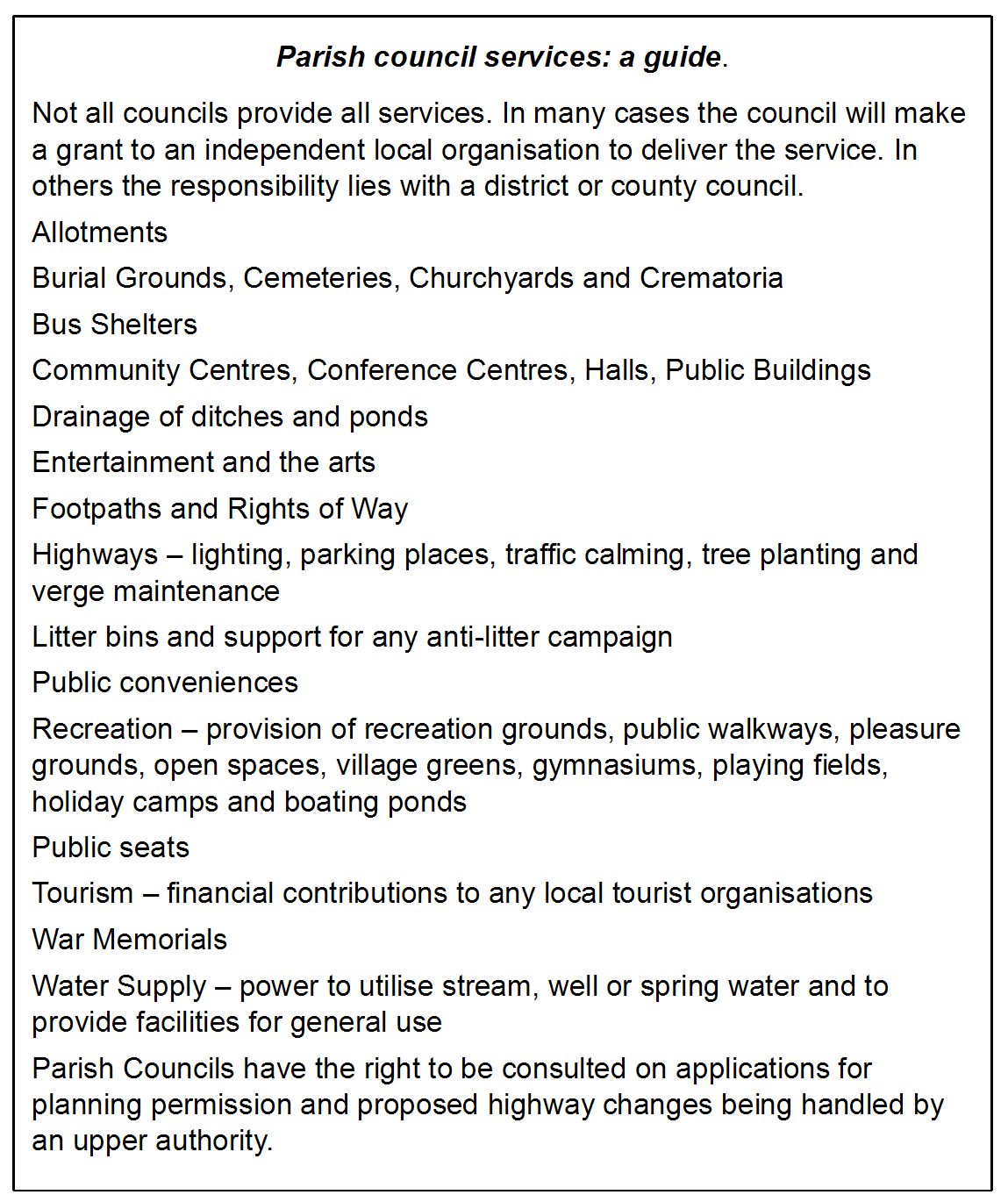
Parish councils vary widely in the services they provide: see box.
It follows that the amounts they charge their residents – the council tax precept – vary widely. Among the 49, the highest and lowest precepts for 2024/25 (excluding Cranbrook, an outlier with a precept of £256.03, and those parishes with a nil precept) were:

CouncilHighest PreceptsCouncilLowest Precepts
Crediton£174.08Whitestone£19.04
Broadclyst£156.22Crediton Hamlets£19.02
Clyst Honiton£144.74Mamhead£8.94

This all gives rise to a serious equity issue inherent in the Exeter proposal, and it centres on council tax. I will try and explain it very simply.

Your council tax bill is made-up of a number of elements, specifically charges levied by different authorities as payment for the services they provide. Bills are sent out by district or unitary councils, so in present case Exeter City Council sends out bills to its residents covering not only payment for the services it provides but also charges (“precepts”) from Devon County Council, the Devon and Cornwall Police and Crime Commissioner and the Devon and Somerset Fire and Rescue Authority. Added together these precepts are transformed into a council tax rate payable according to the banding of your property [Note 3].

Where parish councils exist – as is the case in all the other Devon district council areas – parish council precepts are also added to the council tax bill.

Among the 49, the range of precepts is shown in the table above. Where services are provided by a parish council there is no accordingly no requirement for the district council to provide them and this will feed through into a proportionate reduction in the amount of council tax levied by the district council.

As there are no parish councils in Exeter, the City council provides all these services itself, paid for through the City Council element of the council tax. In the absence of parish councils a new unitary authority will have to provide these services direct in Exeter. It seems highly unlikely that the 49 – particularly the town councils – will be prepared to hand over the running of their local serices to the unitary authority and so they will continue to charge their residents through the parish council precept. It follows that these residents will end up paying twice – once through their own parish council precept and again to the unitary authority for services delivered in Exeter.

What to do?

One approach would be to create a separate town council for Exeter so putting it on the par with the 49. This would enable the unitary council to reduce its own council tax spend by transferring relevant responsibilities and the associated expenditure to the new town council. but it would fly in the face of one of the key aims of the reforms which is a single tier of local government. There are ample precedents for this: on creation of the Somerset unitary council in 2023 its county town, Taunton, established a town council. 5 years before that following the creation of a unitary council for County Durham, the City of Durham district council was replaced by the oddly though accurately named City of Durham Parish Council.

However, the present government has said that it does not want to see any new parish councils created, but then as I’ve observed in the past they do seem to be making this up as they go along.

An alternative would be for all the town and parish councils in the 49 to be abolished with the unitary taking on financial responsibility for the services they currently provide. Local representation on the decision making would then be provided through the government’s favoured neighbourhood area committees but as creatures of the unitary these would have much less clout. Such a move would also have the 49 up in arms against the proposals as well.

The third option is to leave the parish in town councils in place and to address the financial iniquity by modifying the unitary authority council tax in each locality to reflect the payments made by residents to the town or parish council. I’m no expert but I’m pretty sure this would require a substantial rewriting of the current council tax legislation, and it would be a bit of an administrative nightmare.

Rocks and hard places come to mind.

Notes

[1] The Exeter proposal lists parishes, not parish councils. Bicton parish is administered as part of East Budleigh parish council, while the parishes of Clyst St Mary and Sowton now come under a single parish council called Bishop’s Clyst. In addition, 6 very small parishes do not have a parish council but are administered through a Parish Meeting. So there are only 41 actual councils.

[2] I use the term “parish council” to include town councils which have the same legal status.

[3] All council tax figures quoted are for Band D properties.
Much Bindweed in the Marsh

There might be a climate emergency needing urgent shifts to less polluting forms of transport, but getting even a small railway station built seems beyond us.

The title of this post is a play on the name of a BBC radio comedy series, Much Binding in the Marsh, which ran for 10 years after World war 2.  It depicted the chaotic life at a fictional RAF station as the staff grappled with post-war red tape. Over 70 years later, the attempts to build a small railway station at Marsh Barton, a large trading estate in south-west Exeter, are ensnarled in the 21st century version of red tape.

The need for a station at Marsh Barton was first formally identified in the Local Transport Plan 2011-26 [1], published in April 2011.  Three years later an outline business case for the development appeared [2].  The central justification was that the new station – on the main line between Exeter St Davids and Teignmouth – would improve rail links to the area as part of the Devon Metro concept, and so create easier access for people who work in Marsh Barton.  In doing so it would reduce traffic congestion in the estate.  And it would provide a rail link to the proposed large-scale housing developments in south-west Exeter.

Yet the proposed station location is far from convenient.  It was a clear failure of Brunel’s imagination not to realise that 100 years later a large trading estate would be built at Marsh Barton and that his railway would end up going past one edge of it instead of through the middle.  So it’s a 15-minute trot to the other side of the estate, and a good half hour to access the station from the new housing development to the south.  Will we get a frequent shuttle bus service connecting with trains?  Dream on.

Indeed the business case explicitly excludes any planning for bus services and cycle routes linked to the new station.  It also takes little account of the fact that Marsh Barton contains what is held to be one of Europe’s largest concentration of motor vehicle dealers, both sales and servicing. Other traffic is in the form of heavy lorries visiting the industrial units, and traders’ vans and private cars collecting bulky material from the many specialist DIY outlets. None of this can transfer to train.

That said, the main purpose of this post is not to belittle the business case.  The case is based on so much process-driven modelling accepted in consultancy and project management circles that it must have some robustness, surely?  We just have to hope the underlying assumptions are sound and that, despite Devon’s ageing population and other social and technological changes, people carry on behaving as they have in the past when similar stations are opened (because it’s on past trends that much of this modelling is based).  No, what I want to do is look at the whole development process, of which the business case is only one element.

When Brunel built his Great Western Railway out of London Paddington in the 19th century, he had a limited number of hoops to jump through.  He needed Parliamentary approval, finance (from the shareholders), a surveyor, an engineer, materials and navvies.  Admittedly, he wasn’t too hot on health & safety.  When the GWR company board green-lighted him, off he went.  The GWR received its enabling Act of Parliament in 1835 and ran its first trains from London to Maidenhead in 1838.  By 1841, trains were running through from London to Bridgwater in Somerset.

Contrast this with the steps required today to build a small railway station on an existing line.  The outline business case gives a clear summary.  Before a single sod of earth can be touched, the promoters of the scheme – in case this Devon County Council through the Local Transport Board, itself a body nesting within the Heart of the South West Local Enterprise Partnership (the LEP) – need to have secured funding, the necessary permissions based on detailed design work, and appointed a contractor under public sector procurement rules.  The key players in this joint enterprise include: 2 passenger train operating companies and an unidentified number of freight operators, central government, Network Rail, 3 local authorities, 2 rail user groups, business groups, Devon CC’s own transport consultants, the Devon Metro Programme Board, elected representatives, trade unions, nearby residents or other interest groups, and the appointed contractors.  Any one of these can put a spoke in the wheel.  For example, the initial plans assumed a footbridge with a gradient of 1 in 15, but then Notwork Rail popped up to say that 1 in 20 was the maximum steepness permissible.  And, having planned for the structure to be compatible with the electrification of the line the Department for Transport recently stated that electrification will probably not happen after all (as we all know from the Secretary of State’s backsliding on government rail commitments).

The other big obstacle is funding.  Since the coalition government started to starve local authorities of funds and passed them instead to the newly created LEPs on the grounds that they were not Labour’s now-defunct regional development agencies, almost any significant public sector project that is not national or NHS relies on being able to put together a funding package from different sources.  The Marsh Barton station project was originally costed in the business case at £4.3 million, at final approval at £7.4 million, and has since risen, in large measure due to Notwork Rail moving the goalposts, to £13.7 million.  It may go higher.  To fund this, the LEP initially allocated £3.5 million and this may be topped up by underspends om other projects; the remainder is expected to come from government, Network Rail, Community Infrastructure Levy and section 106 agreements with developers, and Devon County Council.  The government recently turned down an application for £3 million from its New Stations Fund.  So after 4 years of planning and negotiations, there is still no certainty that the station can be funded at all.

Does all this planning and fragmented funding really produce a better result at the end of the day?  Or, in this case, will it produce a result at all?  If Brunel had been subject to today’s regime, his railway wouldn’t even have reached Slough.


NOTES

[1]  See https://new.devon.gov.uk/roadsandtransport/traffic-information/transport-planning/devon-and-torbay-local-transport-plan-3-2011-2026/

[2]  Accessible via  http://heartofswlep.co.uk/about-the-lep/how-we-work/local-transport-board/ltb-scheme-business-cases/ f

History speaks

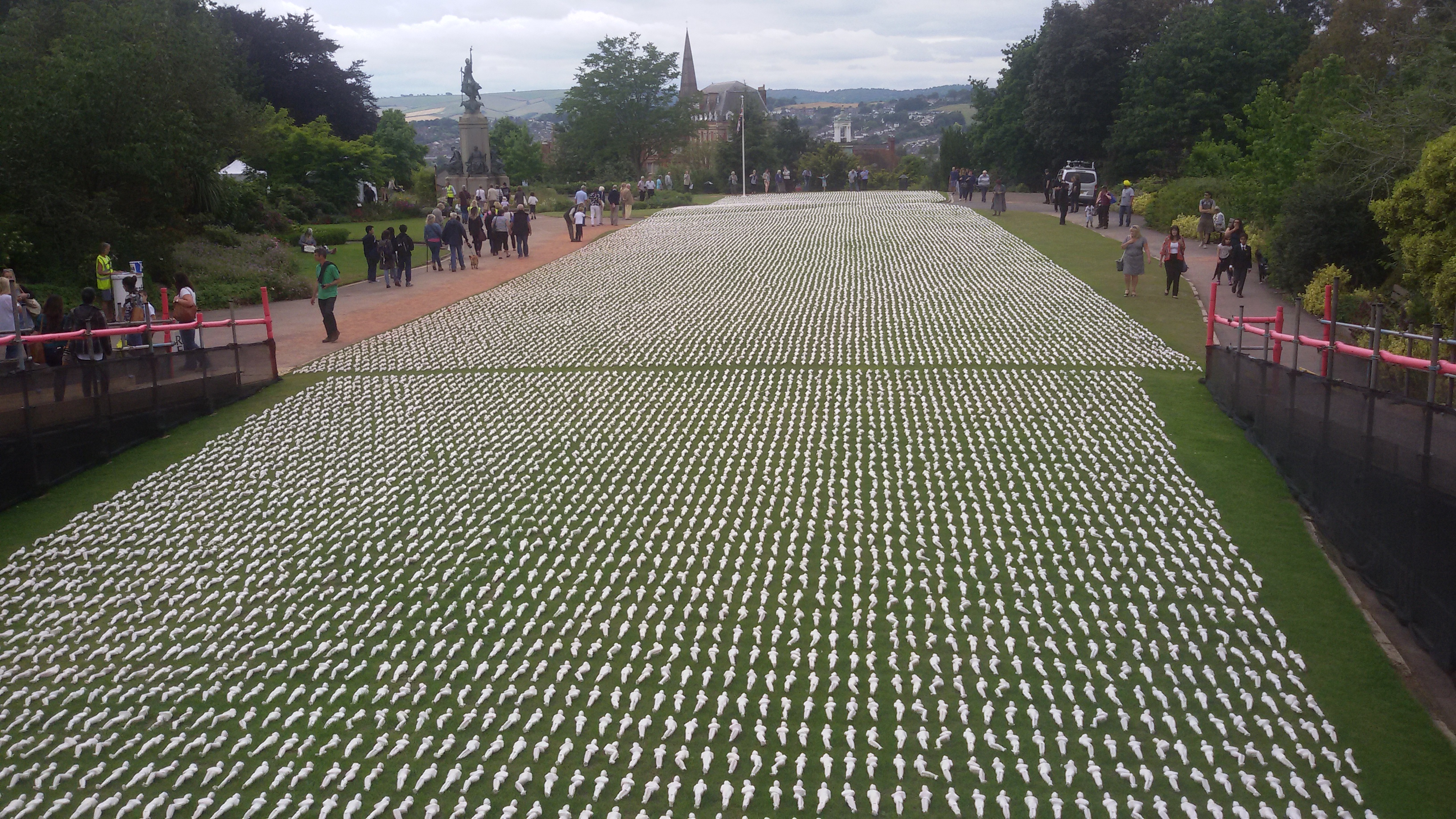
For the first 7 days in July Exeter’s Northernhay Gardens hosted a unique and very moving memorial to the 19,240 allied soldiers who died on the first day of the Battle of the Somme 100 years before.

The project was conceived by Rob Heard, a Somerset artist, and East Devon-based folk singer Steve Knightley.  A website – http://www.thesomme19240.co.uk/ – includes videos and other material about the memorial which enhance understanding.

20160707_161317

The pictures here don’t do it justice.  Each of the tiny shrouds, one for each soldier, was hand-stitched by Rob Heard over a period of three years.  Some 50,000 people – equivalent to nearly half the city’s population – visited the memorial.

20160707_160859

World War One was a travesty of human endeavour.  Fought because governments and dynasties wanted territory, power and trade, and fuelled by nationalism, its principal legacy was the deaths of millions of “ordinary” people.  The flawed post-war settlement laid the ground for the rise of the Nazis and the second world war.  What became the European Union was created to prevent Europe ever going to war within itself again.

It’s a pity the EU referendum didn’t come after the Somme commemorations, rather than before them.  Had it done so, perhaps fewer people would have been prepared to throw away the structure, however imperfect, that has given us 60 years of peace and co-operation.

A little bit of Ireland in Exeter

There are many good things about where we live in Exeter, and the existence of the Globe Inn a short walk away is one of them. Located off the main streets, it’s a comfortable and relaxed place, free of TV sports and High Street yobs. Eclectic but familiar furniture, subdued – but not gloomy – decor, and a decent selection of beers, wine and food. Follow them on Twitter @ExeterGlobe or on Facebook as The Globe.

The third Wednesday of each month is Irish music night at the Globe. Being married to a Dubliner means that this earns a slot in the domestic calendar. Being married to a Dubliner who is also a cousin of the direct descendants of the late and revered Leo Rowsome – the man who brought the sound of the uilleann pipes to a new and much wider audience– means it’s a must-go.

The band is a scratch band: a central core plus whoever else turns up. Last night was a thin evening, and the absence of the fiddle was noticeable, so the pipes were firmly in the ascendant. But we’ve been there when just about every band instrument was represented.

On their own, the pipes can be melancholic, evoking the remoteness, the unhappiness and the resilience of Irish communities over the centuries.  Speed up the tempo, or put the fiddle and a few more in, and it’s the jollity of John Wayne chasing Maureen O’Hara in The Quiet Man.  In keeping with the sociability of the Irish you can carry on a conversation while they’re playing. It’s not background music, but it doesn’t deafen you either. For me, it’s as good as actually being in Ireland.

The Globe hosts other forms of music more usually associated with city centre pubs in England. But it’s great to find a place that welcomes traditional Irish music, performed in the traditional way – no stage, but seated round tables in a corner of the pub. It’s a thousand miles from the cod “Irish bars” to be found in almost every city in Europe where the only pipes you’ll find are in the toilets.

How to fix a consultation

One of Exeter’s less attractive pieces of public realm is the bus and coach station. Draughty, uncomfortable, made of brutalist concrete, and with half the site used exclusively as an overnight bus park, proposals for its redevelopment have been round for years.

Now, however, action is in prospect. The site developers – The Crown Estate and TIAA Henderson Real Estate – recently staged a small exhibition of their plans to gauge public opinion. There was no model, only an outline plan showing areas marked for retail, restaurants, leisure and a cinema, plus a new more compact bus station and a small greened public open space. The development is being presented as an extension of the existing Princesshay shopping centre.

Armed with the public’s views, the developers have said they intend to submit an application for outline planning permission before Christmas. Whether what the developers have collected really represents the public’s views is a moot point. Visitors to the exhibition were asked to complete a form which asked them to express a view on five propositions, by ticking the box for each one to state whether they strongly agreed, agreed, didn’t know, disagreed or strongly disagreed.

Let’s look at the five propositions (in italics), with my comments on each.

1. I think the extension of Princesshay and the proposed leisure facilities are a good thing for the city. No opportunity to support the new leisure facilities – which will be a swimming pool – without supporting the rest of it.
2. I think the bus and coach station is in need of redevelopment to provide a new gateway to Exeter. A no-brainer, barely worth asking.
3. New and accessible public spaces in the city centre will benefit visitors and residents alike. Well, yes, they probably will, but the statement is not related to the development under discussion.
4. I would welcome an increased variety of places to eat and drink and more choice in city centre leisure activities. Again, no opportunity to disaggregate the proposition. Many people in Exeter would like to see a new city centre theatre on the site, but that’s not on offer and the questionnaire doesn’t invite comment on alternatives.
5. I think the city as a whole will benefit from this new proposed development. How can a layman form an informed opinion on this? We don’t know what the new shops and restaurants will be: will they be more chains, or will they be at affordable rents for small businesses? LOL.

The questionnaire aims to encourage respondents to say Yes to the goodies, without any recognition that there could be other issues. For example, there is no invitation to comment on the changes to traffic arrangements arising from the development even though this will have a major (if beneficial) impact on current travel patterns.

Just contrast this slanted approach to consultation with an equally recent major survey from Exeter City Council seeking information to inform its decisions on next year’s reduced budget. To take public parks as an example, the survey asks respondents how often they visit parks, what time of day (with different questions for winter and summer), what they use the parks for, and how far they’d be willing to travel to a park. The survey concludes by asking respondents to assign a priority from 1 to 5 to a range of services: cutting grass; maintaining hedges; pruning & replacing trees; planting & maintaining flower beds; maintaining buildings; maintaining features eg. sculptures, paths, gates, walls & memorials. These are open questions, with no nudging respondents in a particular direction. Which means the results will be worth something.

That’s real consultation.