
If other parts of England are pursuing similar ambitions as Exeter City Council then proposals for reorganising local government risk being derailed once people understand the council tax implications.
The government’s Christmas present to the nation was to embark on reorganising local government in England. According to the White Paper, the aim is to deliver “a generational project of determined devolution”. A key element, justified by an apparent need to streamline the structure of local government, is the ambition for “two tier” structures to disappear. So the remaining county and district councils are to be reformed into single tier unitary authorities.
Devon County Council is one such two-tiered area, and all councils – including the existing unitary authorities of Plymouth and Torbay – have been asked to send the government final proposals for restructuring by 28 November. The chances of them all agreeing on a single way forward are somewhere between negligible and nil.
Exeter City Council is advocating a unitary authority centred on Exeter but incorporating some of the surrounding parishes – 49 on their list [Note 1] – currently in other district council areas. Here’s the list.

A meeting of the City Council on 14 August approved unanimously this geographical plan as the basis for further work. Apart from technical issues, such as finance, there would be consultations with the residents of the 49 areas that would find themselves as part of a Greater Exeter unitary.
Now there’s a lot of sense behind the proposal and anyone interested should read the minutes and paper for the August meeting. But there is a looming problem arising from the existence of parish and town councils among the 49 areas [Note 2]. No such councils exist in the city of Exeter.
What are parish and town councils?
To start by correcting a common misapprehension – they represent civil administrative parishes amd are nothing to do with the parishes of the Church of England. Originally established under powers in the Local Government Act 1894, many have developed to the point where they are responsible for significant local services. This is particularly true of those parish councils which have resolved to call themselves Town Councils: these are Budleigh Salterton, Chudleigh, Cranbrook, Crediton, Dawlish and Exmouth.
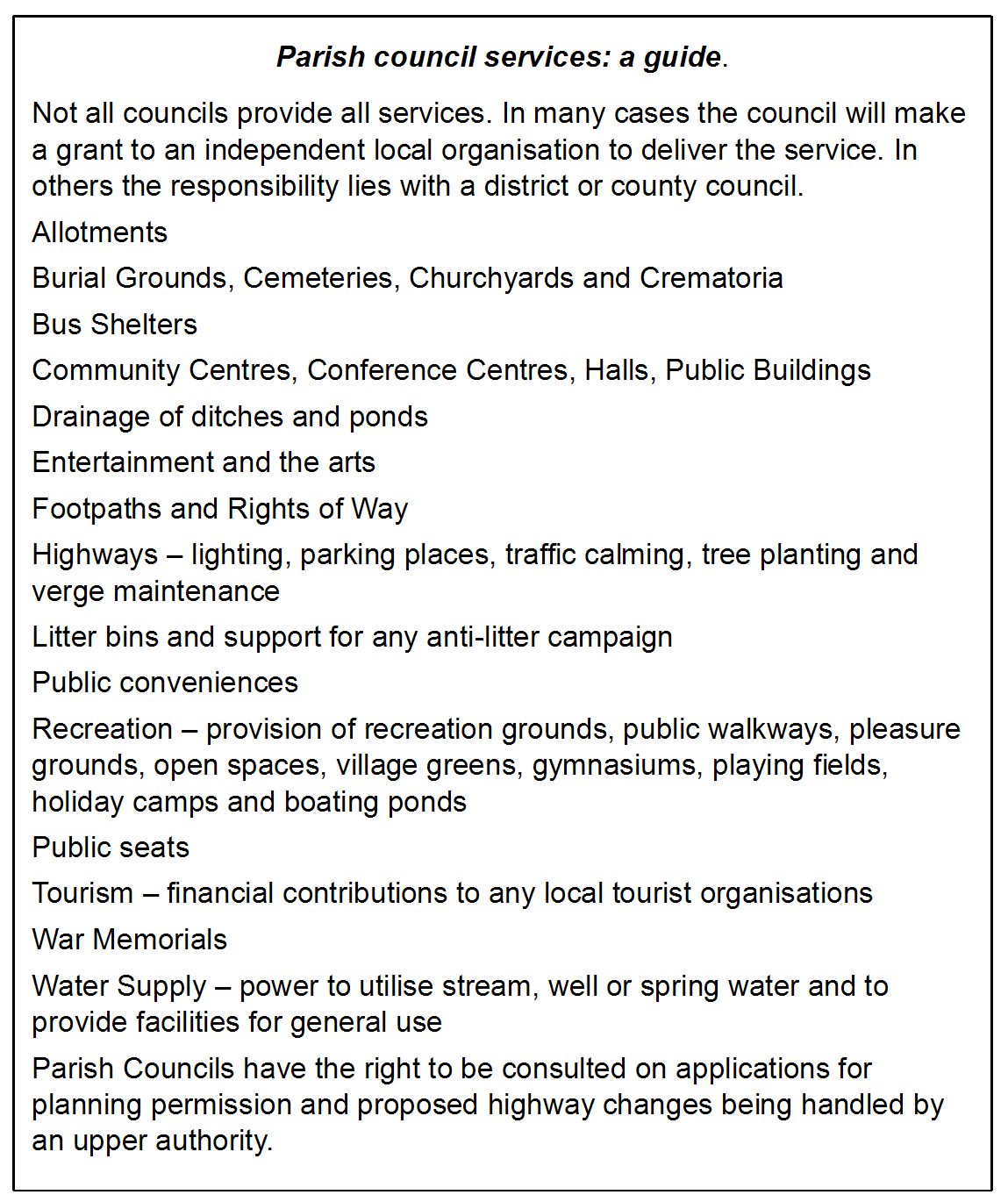
Parish councils vary widely in the services they provide: see box.
It follows that the amounts they charge their residents – the council tax precept – vary widely. Among the 49, the highest and lowest precepts for 2024/25 (excluding Cranbrook, an outlier with a precept of £256.03, and those parishes with a nil precept) were:
| Council | Highest Precepts | Council | Lowest Precepts |
|---|---|---|---|
| Crediton | £174.08 | Whitestone | £19.04 |
| Broadclyst | £156.22 | Crediton Hamlets | £19.02 |
| Clyst Honiton | £144.74 | Mamhead | £8.94 |
This all gives rise to a serious equity issue inherent in the Exeter proposal, and it centres on council tax. I will try and explain it very simply.
Your council tax bill is made-up of a number of elements, specifically charges levied by different authorities as payment for the services they provide. Bills are sent out by district or unitary councils, so in present case Exeter City Council sends out bills to its residents covering not only payment for the services it provides but also charges (“precepts”) from Devon County Council, the Devon and Cornwall Police and Crime Commissioner and the Devon and Somerset Fire and Rescue Authority. Added together these precepts are transformed into a council tax rate payable according to the banding of your property [Note 3].
Where parish councils exist – as is the case in all the other Devon district council areas – parish council precepts are also added to the council tax bill.
Among the 49, the range of precepts is shown in the table above. Where services are provided by a parish council there is no accordingly no requirement for the district council to provide them and this will feed through into a proportionate reduction in the amount of council tax levied by the district council.
As there are no parish councils in Exeter, the City council provides all these services itself, paid for through the City Council element of the council tax. In the absence of parish councils a new unitary authority will have to provide these services direct in Exeter. It seems highly unlikely that the 49 – particularly the town councils – will be prepared to hand over the running of their local serices to the unitary authority and so they will continue to charge their residents through the parish council precept. It follows that these residents will end up paying twice – once through their own parish council precept and again to the unitary authority for services delivered in Exeter.
What to do?
One approach would be to create a separate town council for Exeter so putting it on the par with the 49. This would enable the unitary council to reduce its own council tax spend by transferring relevant responsibilities and the associated expenditure to the new town council. but it would fly in the face of one of the key aims of the reforms which is a single tier of local government. There are ample precedents for this: on creation of the Somerset unitary council in 2023 its county town, Taunton, established a town council. 5 years before that following the creation of a unitary council for County Durham, the City of Durham district council was replaced by the oddly though accurately named City of Durham Parish Council.
However, the present government has said that it does not want to see any new parish councils created, but then as I’ve observed in the past they do seem to be making this up as they go along.
An alternative would be for all the town and parish councils in the 49 to be abolished with the unitary taking on financial responsibility for the services they currently provide. Local representation on the decision making would then be provided through the government’s favoured neighbourhood area committees but as creatures of the unitary these would have much less clout. Such a move would also have the 49 up in arms against the proposals as well.
The third option is to leave the parish in town councils in place and to address the financial iniquity by modifying the unitary authority council tax in each locality to reflect the payments made by residents to the town or parish council. I’m no expert but I’m pretty sure this would require a substantial rewriting of the current council tax legislation, and it would be a bit of an administrative nightmare.
Rocks and hard places come to mind.
Notes
[1] The Exeter proposal lists parishes, not parish councils. Bicton parish is administered as part of East Budleigh parish council, while the parishes of Clyst St Mary and Sowton now come under a single parish council called Bishop’s Clyst. In addition, 6 very small parishes do not have a parish council but are administered through a Parish Meeting. So there are only 41 actual councils.
[2] I use the term “parish council” to include town councils which have the same legal status.
[3] All council tax figures quoted are for Band D properties.








 Peter Cleasby