Tag Archives: devolution

The Council’s (Tax) Dilemma

If other parts of England are pursuing similar ambitions as Exeter City Council then proposals for reorganising local government risk being derailed once people understand the council tax implications.

The government’s Christmas present to the nation was to embark on reorganising local government in England. According to the White Paper, the aim is to deliver “a generational project of determined devolution”. A key element, justified by an apparent need to streamline the structure of local government, is the ambition for “two tier” structures to disappear. So the remaining county and district councils are to be reformed into single tier unitary authorities.

Devon County Council is one such two-tiered area, and all councils – including the existing unitary authorities of Plymouth and Torbay – have been asked to send the government final proposals for restructuring by 28 November. The chances of them all agreeing on a single way forward are somewhere between negligible and nil.

Exeter City Council is advocating a unitary authority centred on Exeter but incorporating some of the surrounding parishes – 49 on their list [Note 1] – currently in other district council areas. Here’s the list.

A meeting of the City Council on 14 August approved unanimously this geographical plan as the basis for further work. Apart from technical issues, such as finance, there would be consultations with the residents of the 49 areas that would find themselves as part of a Greater Exeter unitary.

Now there’s a lot of sense behind the proposal and anyone interested should read the minutes and paper for the August meeting. But there is a looming problem arising from the existence of parish and town councils among the 49 areas [Note 2]. No such councils exist in the city of Exeter.

What are parish and town councils?

To start by correcting a common misapprehension – they represent civil administrative parishes amd are nothing to do with the parishes of the Church of England. Originally established under powers in the Local Government Act 1894, many have developed to the point where they are responsible for significant local services. This is particularly true of those parish councils which have resolved to call themselves Town Councils: these are Budleigh Salterton, Chudleigh, Cranbrook, Crediton, Dawlish and Exmouth.

Parish councils vary widely in the services they provide: see box.
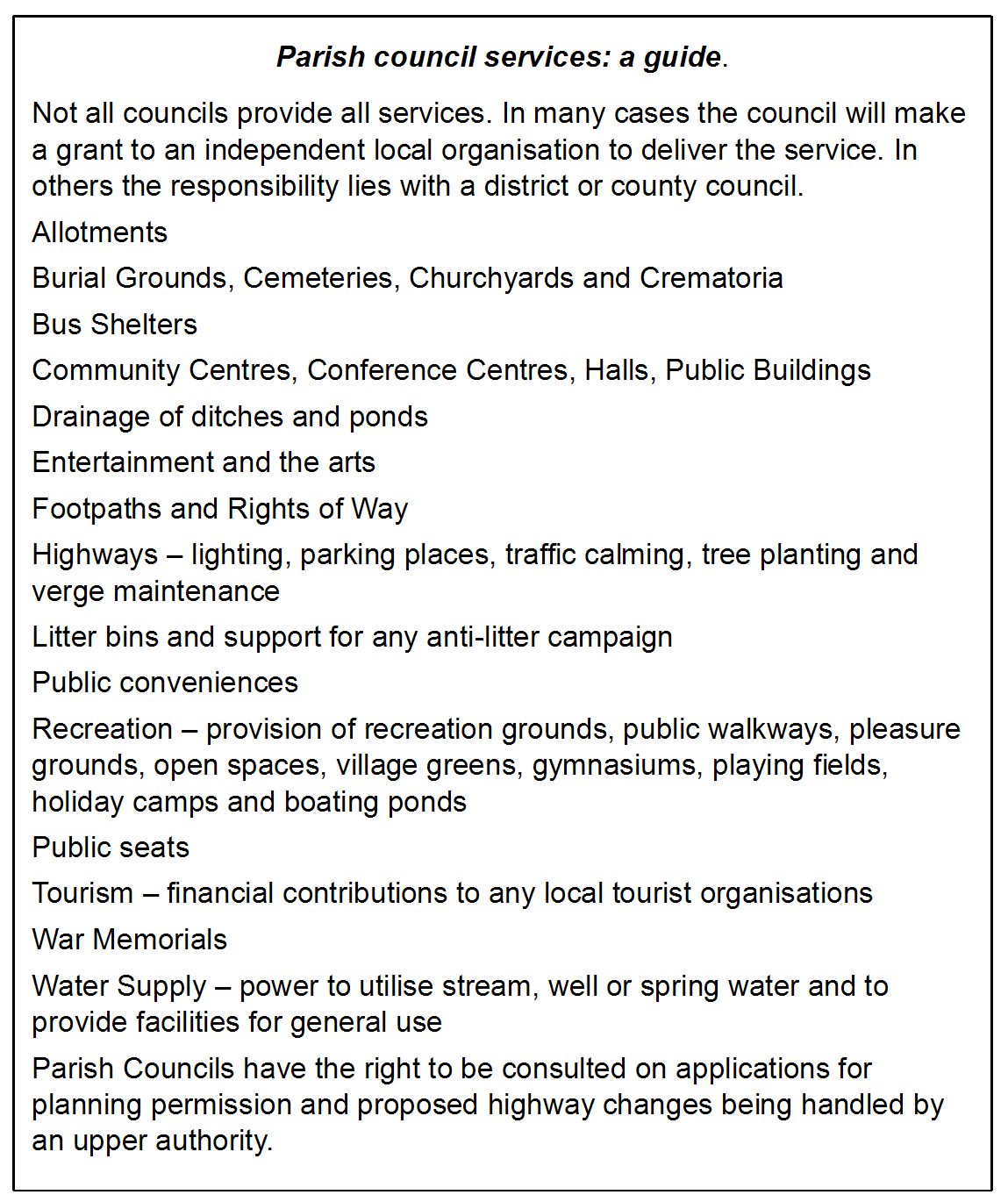
It follows that the amounts they charge their residents – the council tax precept – vary widely. Among the 49, the highest and lowest precepts for 2024/25 (excluding Cranbrook, an outlier with a precept of £256.03, and those parishes with a nil precept) were:

CouncilHighest PreceptsCouncilLowest Precepts
Crediton£174.08Whitestone£19.04
Broadclyst£156.22Crediton Hamlets£19.02
Clyst Honiton£144.74Mamhead£8.94

This all gives rise to a serious equity issue inherent in the Exeter proposal, and it centres on council tax. I will try and explain it very simply.

Your council tax bill is made-up of a number of elements, specifically charges levied by different authorities as payment for the services they provide. Bills are sent out by district or unitary councils, so in present case Exeter City Council sends out bills to its residents covering not only payment for the services it provides but also charges (“precepts”) from Devon County Council, the Devon and Cornwall Police and Crime Commissioner and the Devon and Somerset Fire and Rescue Authority. Added together these precepts are transformed into a council tax rate payable according to the banding of your property [Note 3].

Where parish councils exist – as is the case in all the other Devon district council areas – parish council precepts are also added to the council tax bill.

Among the 49, the range of precepts is shown in the table above. Where services are provided by a parish council there is no accordingly no requirement for the district council to provide them and this will feed through into a proportionate reduction in the amount of council tax levied by the district council.

As there are no parish councils in Exeter, the City council provides all these services itself, paid for through the City Council element of the council tax. In the absence of parish councils a new unitary authority will have to provide these services direct in Exeter. It seems highly unlikely that the 49 – particularly the town councils – will be prepared to hand over the running of their local serices to the unitary authority and so they will continue to charge their residents through the parish council precept. It follows that these residents will end up paying twice – once through their own parish council precept and again to the unitary authority for services delivered in Exeter.

What to do?

One approach would be to create a separate town council for Exeter so putting it on the par with the 49. This would enable the unitary council to reduce its own council tax spend by transferring relevant responsibilities and the associated expenditure to the new town council. but it would fly in the face of one of the key aims of the reforms which is a single tier of local government. There are ample precedents for this: on creation of the Somerset unitary council in 2023 its county town, Taunton, established a town council. 5 years before that following the creation of a unitary council for County Durham, the City of Durham district council was replaced by the oddly though accurately named City of Durham Parish Council.

However, the present government has said that it does not want to see any new parish councils created, but then as I’ve observed in the past they do seem to be making this up as they go along.

An alternative would be for all the town and parish councils in the 49 to be abolished with the unitary taking on financial responsibility for the services they currently provide. Local representation on the decision making would then be provided through the government’s favoured neighbourhood area committees but as creatures of the unitary these would have much less clout. Such a move would also have the 49 up in arms against the proposals as well.

The third option is to leave the parish in town councils in place and to address the financial iniquity by modifying the unitary authority council tax in each locality to reflect the payments made by residents to the town or parish council. I’m no expert but I’m pretty sure this would require a substantial rewriting of the current council tax legislation, and it would be a bit of an administrative nightmare.

Rocks and hard places come to mind.

Notes

[1] The Exeter proposal lists parishes, not parish councils. Bicton parish is administered as part of East Budleigh parish council, while the parishes of Clyst St Mary and Sowton now come under a single parish council called Bishop’s Clyst. In addition, 6 very small parishes do not have a parish council but are administered through a Parish Meeting. So there are only 41 actual councils.

[2] I use the term “parish council” to include town councils which have the same legal status.

[3] All council tax figures quoted are for Band D properties.

Wanted: discipline in government affairs

The Labour government is understandably in a hurry but risks making a profound mess of local government and diverting effort from its new homes target.

A long. long time ago, when I was a civil servant, project and programme management was all the rage. Perhaps it still is, despite the bad press it got after the service allowed management consultants to set up numberless programme offices everywhere whose principal output was to demand “progress” reports from the people doing the work and to regurgitate these in full colour to programme boards. Personally I avoided them, particularly after a consultant appeared in my office to tell me that I couldn’t have my programme manager on my programme board because it was against PRINCE 2 rules. After being abruptly directed to my door, he was never seen again on my patch.

None of this is to suggest that I don’t see a role for well-conceived programmes and projects: on the contrary, one of my final roles in the civil service was as a reviewer in the now-departed Office of Government Commerce, an agency of HM Treasury. Small teams of us would descend on high-risk programmes and projects to find out whether they were being run properly. Highly enjoyable.

Which brings me to the present day. What is going on in the local government directorate of the Ministry of Housing, Communities and Local Government (MHCLG) makes one wonder whether they’ve abandoned programme management (perhaps due to a surfeit of consultants?) or whether it never took root in the Ministry in the first place. Or perhaps its practitioners just don’t know how do it

However you look at it, local government in England has been overwhelmed by a series of MHCLG initiatives which purport to add up to a coherent whole, but – at least viewed from the coal face – do nothing of the sort.

For those readers wishing to look at a detailed study of the mayhem, the Exeter Observer team have produced an excellent deep-dive analysis of what is happening in Devon: read it here.

Currently the only public aims and objectives statement that I can find for the MHCLG is on the gov.uk website:

Setting aside the unfortunate image of senior civil servants in hard hats and boots digging in the mud, the statement encapsulates three distinct actual work streams:

  • increasing the number of homes, with a target of 370,000 each year
  • devolution, under which powers are to be devolved from Whitehall to local authorities and elected mayors
  • local government reorganisation, seen from Whitehall – though possibly from nowhere else apart from public-sector-hating think tanks – as an essential pre-condition for achieving growth

The first of these is arguably the least controversial and is a key commitment in the Prime Minister’s Plan for Change. Given the belief that local planning authorities control the pace of house building (a long-held Whitehall view which glosses over the inconvenient truth that building firms, not councils, build most houses) it’s a bit odd that the government is distracting authorities from their housing task by a reorganisation, which is nowhere mentioned in the Plan for Change. Nor does the 2024 Labour Manifesto hint at the scale of upheaval to come.

Let’s be clear. To speed up housing delivery you do not need to abolish all the district-level planning authorities, which is what the government intends to do. All that is required in the public sphere is change to the National Planning Policy Framework of which a new edition was published in December 2024.

On devolution, the government set out its stall in a white paper published on 16 December 2024. Now call me old fashioned, but this did seem to be jumping the gun. White papers are supposed to be the product of extensive analysis, consultation and thought: indeed the Cabinet Office guidance on making legislation situates a white paper as follows: “the normal stages in policy development: a green paper discussion or consultation document, a white paper (major policy proposals set out in more detail) and one or more rounds of public consultation.”

So what did we get? For starters, a document using expressions such a “having skin in the game”. I had to look up its meaning.

Bearing in mind that a white paper is supposed to be a statement of government policy, the following sentence from it is a bit gob-smacking:

In other words, when publishing the white paper the government hadn’t a clue what sustainable unitary structures are or how it would judge proposals submitted to it.

Just how vague the government’s views are is exemplified by looking at policy on the size of the new councils.

On the unitary authorities the white paper states:

And on strategic authorities:

I, and others, asked MHCLG what the evidence for these figures was. The response pointed to a 2020 report as support for the unitary 500,000 figure. The white paper explains:

No mention of size there. However, the relevant section of the PWC report states:

That’s helpfully precise.

In 2006 the then DCLG, a predecessor of MHCLG, published a study entitled Population Size and Local Authority Performance, carried out by the Centre for Local & Regional Government Research at Cardiff University. The fieldwork is now some 20 years old.

The conclusions of the Cardiff study were cautious:

But PWC put a stronger spin on it, describing the work as:

Interesting to note that the metrics which did apparently not improve with size – CPA, Best Value and VFM – are those of greatest interest to HM Treasury.

The cautionary notes in the original study have been set aside in the PWC summary. But then PWC and their ilk did not get rich by failing to give their clients what they wanted. Since in this case the client was the County Councils Association, the PWC spin is no surprise.

As for the posited 1.5 million population for a strategic authority, no evidence was offered by MHCLG.

One last thought about this shambles. On 12 December 2024 the government published a new version of the NPPF, which included new house building targets for councils to be included in their local plans. But the new framework introduced a new mandatory methodology for calculating the housing needs for each area. So the requirement for my home city of Exeter – which before 12 December 2024 was 642 new homes annually – is now 800. Since getting more homes built is a key government objective, this approach is reasonable, even welcome.

But here’s the rub. Transitional arrangements allow plans which are as advanced as Exeter’s to go forward for examination and approval using the pre-December homes targets. It requires a more imaginative mind than mine to see the value in spending 18 months more work on a plan whose sites strategy has already been overtaken by government policy.

I wish I’d been able to review the MHCLG programme plan for all this!

Devolution doesn’t always mean taking back control

Since Tony Blair became prime minister in 1997, successive UK governments have fiddled around with ways of devolving power from Westminster and Whitehall.  The most radical has been Scottish devolution, which continues to evolve.  The least coherent has been the patchwork of schemes developed across England, ranging from a well-thought out arrangement for London, with a directly elected mayor and assembly, to the make-it-up-as-you-go-along “devolution deals” for the rest.

The coalition government of 2010-15 abolished – wisely – the regional governance bureaucracies.  The first big replacement idea was Local Enterprise Partnerships (LEPs), intended as “business-led” mechanisms for spending public money.  The areas covered by LEPs were in some cases obvious, based for example on established city regions or former metropolitan counties.  In others the rationale was less clear, perhaps nowhere more so than the Heart of the South West (HotSW) LEP, covering a massive area from Plymouth to the south of Bristol [1].  It’s tempting to think that after Cornwall decided to go their own way and Bristol wasn’t having any truck with its Somerset neighbours, that HotSW was the “bit left over”.

The performance of these fundamentally secretive and undemocratic bodies is not the focus of this post [2].  They are relevant because the LEP areas have in some cases – including HotSW – formed the basis of the subsequent devolution proposals in England.

The government has been inviting groups of local authorities to submit proposals for devolving decision-making in certain functions, particularly infrastructure and economic development, but not limited to these.  The rationale behind this approach is that increasing productivity, a key goal of government policy, is best achieved by local targeting of support measures through local authorities and business interests working together.  The government has made it clear that access to some central funding is dependent on devolution deals being agreed.  Invariably, local authorities across the area commit to setting up a “combined authority” to take the decisions.  Unlike London, this would not be directly elected but would be made up of the leaders of the constituent councils plus non-elected representatives of the NHS and the LEP.  Initially, agreement to a having directly-elected mayor was a condition of a devolution deal but the government now seems to be less rigid on this.

One of the problems with this approach is that it was designed for large urban areas.  Greater Manchester, for example, has operated as a partnership of councils across a coherent area since the 1960s when Passenger Transport Authorities were set up.  Manchester is the trail-blazer in the current devolution game, and it clearly works for them.

What is less clear is that the combined authority structure will work well in those areas of England that aren’t part of a conurbation.  A pretentious-sounding body called The Independent Commission on Economic Growth and the Future of Public Services in Non-Metropolitan England produced a report last year arguing for devolution deals for the rest of England [3].  It does make the useful point that LEP areas do not in most cases coincide with functional economic areas (a conclusion which should be enough to discredit the whole idea of LEPs), but is otherwise a typical product of this debate in that it focusses on structures and “partnerships” from which communities are largely excluded.

The councils within the HotSW area have submitted a devolution bid to the government [4].  The bid identifies 6 challenges for the area (low productivity growth, limited labour market, patchy performance in innovation and enterprise, an ageing population, health and care integration, infrastructure and connectivity) and 6 “Golden Opportunities” for improving growth and productivity (marine, nuclear, aerospace and advanced engineering, data analytics, rural productivity, health and care).  The bid has a wholly economic focus: other than in references to care, the word “social” does not appear in the document, and there is no acknowledgement of the impacts of the plans on the natural environment.

If the bid succeeds – and at least some of the councils are treating the whole exercise with a degree of caution – decision-making on the plans and services covered by the bid will be sucked upwards from the councils and the people they represent.  How the combined authority will balance the interests of, say, Plymouth with those of people in the Mendips will be discussed in officer-led groups behind closed doors – because that is the only way “partnership” working can be made to operate in practice.  The need to prepare for joint meetings gives authority officers huge influence over agendas and decisions because of the need to coordinate positions and identify common solutions in advance of meetings.

The combined authority itself will be made up of leaders of the constituent councils and others.  It will not be directly elected.  Trying to influence its decisions will be next to impossible for individuals and community groups.  The bid’s economic focus ignores environmental and community questions completely, so being able to provide a counter-balance is hugely important.  As it is, the bid’s environmental credentials are defined by the partnership’s LEP-led role as a cheerleader for the new Hinkley Point nuclear power station.

Other devolution bids across England generate similar challenges.  At a time when disillusion with our politics is at an all-time high, it is puzzling – to put it mildly – that decision-making is to move even further away from the people most affected


NOTES:

[1]  The map of LEP areas at www.lepnetwork.net/the-network-of-leps/ shows just how large the area is.

[2]  An excellent House of Commons briefing note (July 2016) provides a concise guide to LEPs including reviews of their performance – see www.parliament.uk/briefing-papers/sn05651.pdf

[3]  See www.local.gov.uk/non-met-commission

[4]  The bid document is at https://new.devon.gov.uk/democracy/files/2016/01/Heart-of-the-South-West-Devolution-Prospectus.pdf