Author Archives: Peter Cleasby

Unknown's avatar

About Peter Cleasby

.

The Council’s (Tax) Dilemma

If other parts of England are pursuing similar ambitions as Exeter City Council then proposals for reorganising local government risk being derailed once people understand the council tax implications.

The government’s Christmas present to the nation was to embark on reorganising local government in England. According to the White Paper, the aim is to deliver “a generational project of determined devolution”. A key element, justified by an apparent need to streamline the structure of local government, is the ambition for “two tier” structures to disappear. So the remaining county and district councils are to be reformed into single tier unitary authorities.

Devon County Council is one such two-tiered area, and all councils – including the existing unitary authorities of Plymouth and Torbay – have been asked to send the government final proposals for restructuring by 28 November. The chances of them all agreeing on a single way forward are somewhere between negligible and nil.

Exeter City Council is advocating a unitary authority centred on Exeter but incorporating some of the surrounding parishes – 49 on their list [Note 1] – currently in other district council areas. Here’s the list.

A meeting of the City Council on 14 August approved unanimously this geographical plan as the basis for further work. Apart from technical issues, such as finance, there would be consultations with the residents of the 49 areas that would find themselves as part of a Greater Exeter unitary.

Now there’s a lot of sense behind the proposal and anyone interested should read the minutes and paper for the August meeting. But there is a looming problem arising from the existence of parish and town councils among the 49 areas [Note 2]. No such councils exist in the city of Exeter.

What are parish and town councils?

To start by correcting a common misapprehension – they represent civil administrative parishes amd are nothing to do with the parishes of the Church of England. Originally established under powers in the Local Government Act 1894, many have developed to the point where they are responsible for significant local services. This is particularly true of those parish councils which have resolved to call themselves Town Councils: these are Budleigh Salterton, Chudleigh, Cranbrook, Crediton, Dawlish and Exmouth.

Parish councils vary widely in the services they provide: see box.
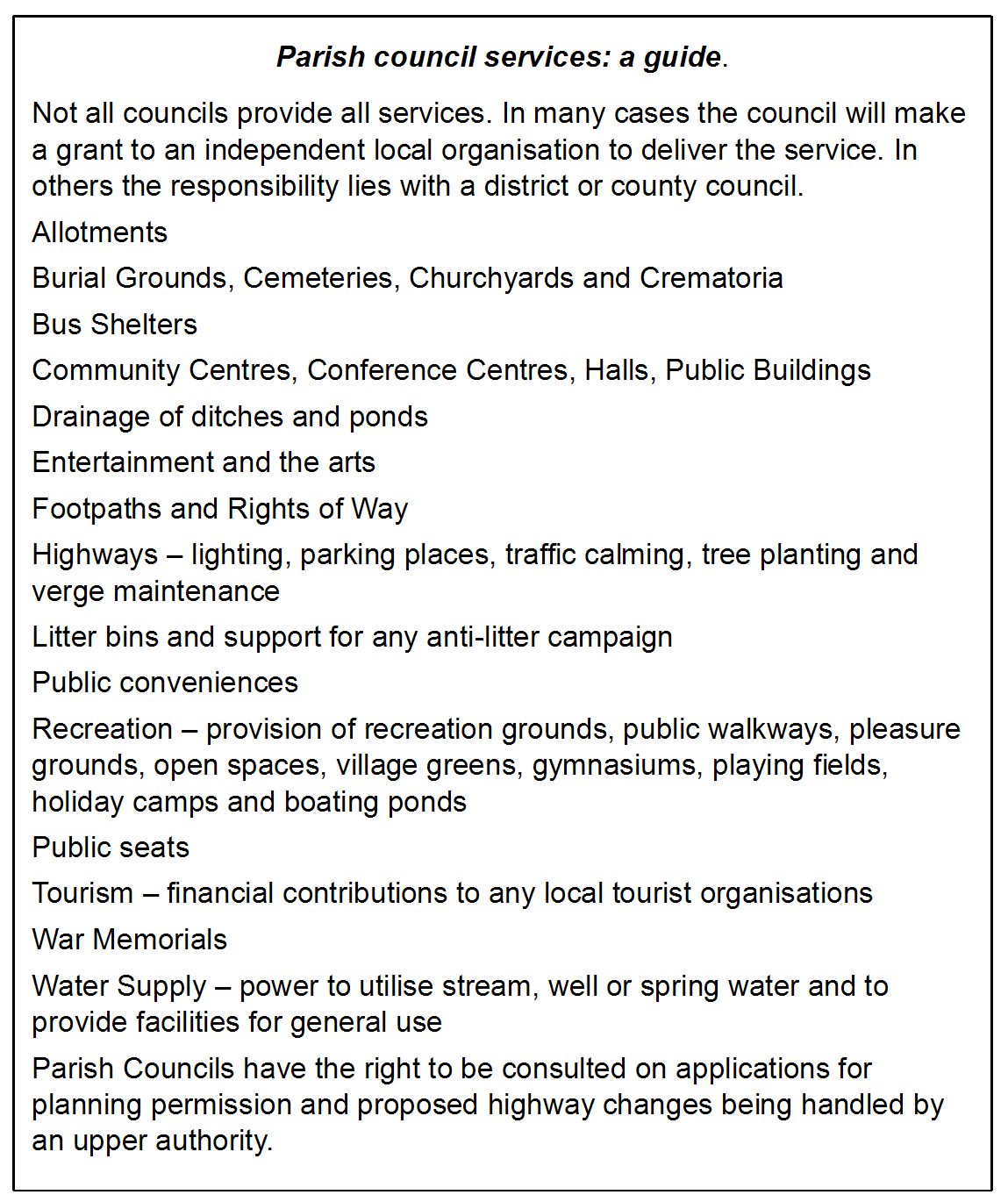
It follows that the amounts they charge their residents – the council tax precept – vary widely. Among the 49, the highest and lowest precepts for 2024/25 (excluding Cranbrook, an outlier with a precept of £256.03, and those parishes with a nil precept) were:

CouncilHighest PreceptsCouncilLowest Precepts
Crediton£174.08Whitestone£19.04
Broadclyst£156.22Crediton Hamlets£19.02
Clyst Honiton£144.74Mamhead£8.94

This all gives rise to a serious equity issue inherent in the Exeter proposal, and it centres on council tax. I will try and explain it very simply.

Your council tax bill is made-up of a number of elements, specifically charges levied by different authorities as payment for the services they provide. Bills are sent out by district or unitary councils, so in present case Exeter City Council sends out bills to its residents covering not only payment for the services it provides but also charges (“precepts”) from Devon County Council, the Devon and Cornwall Police and Crime Commissioner and the Devon and Somerset Fire and Rescue Authority. Added together these precepts are transformed into a council tax rate payable according to the banding of your property [Note 3].

Where parish councils exist – as is the case in all the other Devon district council areas – parish council precepts are also added to the council tax bill.

Among the 49, the range of precepts is shown in the table above. Where services are provided by a parish council there is no accordingly no requirement for the district council to provide them and this will feed through into a proportionate reduction in the amount of council tax levied by the district council.

As there are no parish councils in Exeter, the City council provides all these services itself, paid for through the City Council element of the council tax. In the absence of parish councils a new unitary authority will have to provide these services direct in Exeter. It seems highly unlikely that the 49 – particularly the town councils – will be prepared to hand over the running of their local serices to the unitary authority and so they will continue to charge their residents through the parish council precept. It follows that these residents will end up paying twice – once through their own parish council precept and again to the unitary authority for services delivered in Exeter.

What to do?

One approach would be to create a separate town council for Exeter so putting it on the par with the 49. This would enable the unitary council to reduce its own council tax spend by transferring relevant responsibilities and the associated expenditure to the new town council. but it would fly in the face of one of the key aims of the reforms which is a single tier of local government. There are ample precedents for this: on creation of the Somerset unitary council in 2023 its county town, Taunton, established a town council. 5 years before that following the creation of a unitary council for County Durham, the City of Durham district council was replaced by the oddly though accurately named City of Durham Parish Council.

However, the present government has said that it does not want to see any new parish councils created, but then as I’ve observed in the past they do seem to be making this up as they go along.

An alternative would be for all the town and parish councils in the 49 to be abolished with the unitary taking on financial responsibility for the services they currently provide. Local representation on the decision making would then be provided through the government’s favoured neighbourhood area committees but as creatures of the unitary these would have much less clout. Such a move would also have the 49 up in arms against the proposals as well.

The third option is to leave the parish in town councils in place and to address the financial iniquity by modifying the unitary authority council tax in each locality to reflect the payments made by residents to the town or parish council. I’m no expert but I’m pretty sure this would require a substantial rewriting of the current council tax legislation, and it would be a bit of an administrative nightmare.

Rocks and hard places come to mind.

Notes

[1] The Exeter proposal lists parishes, not parish councils. Bicton parish is administered as part of East Budleigh parish council, while the parishes of Clyst St Mary and Sowton now come under a single parish council called Bishop’s Clyst. In addition, 6 very small parishes do not have a parish council but are administered through a Parish Meeting. So there are only 41 actual councils.

[2] I use the term “parish council” to include town councils which have the same legal status.

[3] All council tax figures quoted are for Band D properties.

Wanted: discipline in government affairs

The Labour government is understandably in a hurry but risks making a profound mess of local government and diverting effort from its new homes target.

A long. long time ago, when I was a civil servant, project and programme management was all the rage. Perhaps it still is, despite the bad press it got after the service allowed management consultants to set up numberless programme offices everywhere whose principal output was to demand “progress” reports from the people doing the work and to regurgitate these in full colour to programme boards. Personally I avoided them, particularly after a consultant appeared in my office to tell me that I couldn’t have my programme manager on my programme board because it was against PRINCE 2 rules. After being abruptly directed to my door, he was never seen again on my patch.

None of this is to suggest that I don’t see a role for well-conceived programmes and projects: on the contrary, one of my final roles in the civil service was as a reviewer in the now-departed Office of Government Commerce, an agency of HM Treasury. Small teams of us would descend on high-risk programmes and projects to find out whether they were being run properly. Highly enjoyable.

Which brings me to the present day. What is going on in the local government directorate of the Ministry of Housing, Communities and Local Government (MHCLG) makes one wonder whether they’ve abandoned programme management (perhaps due to a surfeit of consultants?) or whether it never took root in the Ministry in the first place. Or perhaps its practitioners just don’t know how do it

However you look at it, local government in England has been overwhelmed by a series of MHCLG initiatives which purport to add up to a coherent whole, but – at least viewed from the coal face – do nothing of the sort.

For those readers wishing to look at a detailed study of the mayhem, the Exeter Observer team have produced an excellent deep-dive analysis of what is happening in Devon: read it here.

Currently the only public aims and objectives statement that I can find for the MHCLG is on the gov.uk website:

Setting aside the unfortunate image of senior civil servants in hard hats and boots digging in the mud, the statement encapsulates three distinct actual work streams:

  • increasing the number of homes, with a target of 370,000 each year
  • devolution, under which powers are to be devolved from Whitehall to local authorities and elected mayors
  • local government reorganisation, seen from Whitehall – though possibly from nowhere else apart from public-sector-hating think tanks – as an essential pre-condition for achieving growth

The first of these is arguably the least controversial and is a key commitment in the Prime Minister’s Plan for Change. Given the belief that local planning authorities control the pace of house building (a long-held Whitehall view which glosses over the inconvenient truth that building firms, not councils, build most houses) it’s a bit odd that the government is distracting authorities from their housing task by a reorganisation, which is nowhere mentioned in the Plan for Change. Nor does the 2024 Labour Manifesto hint at the scale of upheaval to come.

Let’s be clear. To speed up housing delivery you do not need to abolish all the district-level planning authorities, which is what the government intends to do. All that is required in the public sphere is change to the National Planning Policy Framework of which a new edition was published in December 2024.

On devolution, the government set out its stall in a white paper published on 16 December 2024. Now call me old fashioned, but this did seem to be jumping the gun. White papers are supposed to be the product of extensive analysis, consultation and thought: indeed the Cabinet Office guidance on making legislation situates a white paper as follows: “the normal stages in policy development: a green paper discussion or consultation document, a white paper (major policy proposals set out in more detail) and one or more rounds of public consultation.”

So what did we get? For starters, a document using expressions such a “having skin in the game”. I had to look up its meaning.

Bearing in mind that a white paper is supposed to be a statement of government policy, the following sentence from it is a bit gob-smacking:

In other words, when publishing the white paper the government hadn’t a clue what sustainable unitary structures are or how it would judge proposals submitted to it.

Just how vague the government’s views are is exemplified by looking at policy on the size of the new councils.

On the unitary authorities the white paper states:

And on strategic authorities:

I, and others, asked MHCLG what the evidence for these figures was. The response pointed to a 2020 report as support for the unitary 500,000 figure. The white paper explains:

No mention of size there. However, the relevant section of the PWC report states:

That’s helpfully precise.

In 2006 the then DCLG, a predecessor of MHCLG, published a study entitled Population Size and Local Authority Performance, carried out by the Centre for Local & Regional Government Research at Cardiff University. The fieldwork is now some 20 years old.

The conclusions of the Cardiff study were cautious:

But PWC put a stronger spin on it, describing the work as:

Interesting to note that the metrics which did apparently not improve with size – CPA, Best Value and VFM – are those of greatest interest to HM Treasury.

The cautionary notes in the original study have been set aside in the PWC summary. But then PWC and their ilk did not get rich by failing to give their clients what they wanted. Since in this case the client was the County Councils Association, the PWC spin is no surprise.

As for the posited 1.5 million population for a strategic authority, no evidence was offered by MHCLG.

One last thought about this shambles. On 12 December 2024 the government published a new version of the NPPF, which included new house building targets for councils to be included in their local plans. But the new framework introduced a new mandatory methodology for calculating the housing needs for each area. So the requirement for my home city of Exeter – which before 12 December 2024 was 642 new homes annually – is now 800. Since getting more homes built is a key government objective, this approach is reasonable, even welcome.

But here’s the rub. Transitional arrangements allow plans which are as advanced as Exeter’s to go forward for examination and approval using the pre-December homes targets. It requires a more imaginative mind than mine to see the value in spending 18 months more work on a plan whose sites strategy has already been overtaken by government policy.

I wish I’d been able to review the MHCLG programme plan for all this!

An odd and ancient law

When it comes to the monarchy, Parliament seems content to leave obsolete draconian restrictions on the statute book.

Have a look at this.

“If any person whatsoever shall, within the United Kingdom or without, compass, imagine, invent, devise, or intend to deprive or depose our Most Gracious Lady the Queen, from the style, honour, or royal name of the imperial crown of the United Kingdom, or of any other of her Majesty’s dominions and countries, [….] and such compassings, imaginations, inventions, devices, or intentions, or any of them, shall express, utter, or declare, by publishing any printing or writing or by any overt act or deed, every person so offending shall be guilty of felony, and being convicted thereof shall be liable to be transported beyond the seas for the term or his or her natural life.”  (Section 3 of the Treason Felony Act 1848)

With the proviso that the reference to transportation was subsequently amended to mean “imprisonment for life or any shorter term” this law, dating from the early years of Queen Victoria’s reign, is still in force.

Concerned that a campaign by the Guardian in 2000 seeking to replace the monarchy with a republic might fall foul of the 1848 law, the paper’s then editor mounted a legal challenge which sought to achieve clarity. Sadly, the law lords gave it short shrift. They all agreed that the 1848 Act was obsolete, though it was for Parliament not the courts to tidy up the statute book. The Human Rights Act 1998 put the matter beyond sensible debate. As Lord Steyn said in his judgement: “Any suggestion that a total legislative ban on republican discourse in print could be compatible with article 10 [of the European Convention on Human Rights] would stretch judicial gullibility to breaking point.”  

The latest so-called Conservative government includes a Home Secretary who is on record as wanting not only to repeal the Human Rights Act but for the UK to withdraw from acceptance of the European Convention itself.  Although such a move does not seem to be a priority at present, it is of course an interesting and moot point as to whether such action would remove the practical ineffectiveness of the 1848 Act, thus putting at risk of prosecution anyone who argues in favour of replacing the UK’s current arrangements for its head of state.

Or will Parliament take the opportunity to repeal what remains of the 1848 Act? Whatever our politicians may say in public, surely some of them fancy being the first elected president of the United Kingdom?

Listening is just that

Election candidates do themselves, their electorates and democracy itself no favours by implying that people will always get what they want.

Every so often, certain words attract a currency that culminates in overkill and, ultimately, become meaningless.  Who will ever forget, during the first few months of the pandemic, the daily parade of government ministers telling us they would “ramp up” such and such a measure?  Presumably the spin doctors consider words with a more precise meaning, such as “increase”, are considered unsuited to the task; and ministers don’t have the balls to overrule them (or, worse, they agree with parroting this same language day in day out). The fact that the promised rampings-up often failed to happen, or if they did, failed to do the jobs claimed for them, added to the unreality.

“Sustainable” is another word that has been abused to death. Brought into political dialogue in 1987 by the Brundtland Commission which defined sustainable development as the concept of “understanding how to meet the needs of the present without compromising the ability of future generations to meet their own needs.”, it was seen as a means of balancing economic, social and environmental demands.

Over the intervening years, the term found itself dragged into service to justify all manner of doubtful practices. In particular the UK’s coalition government’s planning policies – the ones that weight the planning system in favour of volume house builders and other developers – have the gall to claim to be “sustainable”, irrespective of the environmental and social consequences of allowing housing estates to run rampant on greenfield sites and accommodation barely fit for human habitation.

And now, as we engage (or not) in a periodic bout of democratic activity, another word is joining the overkill category: “listen”. It’s an old and well-understood word, which has again been hijacked for a specific message.  If you look at leaflets from candidates in the forthcoming local authority elections, almost all promise to “listen” to their residents as if this is a novel political talisman which will blow away the widespread alienation of people from political processes.

Depending on who the candidate is, this promise has a value. A candidate who is a leading member of the party in control of the council, and which is expected to retain control after 6 May, can make that promise with at least some prospect of the results of “listening” being carried through into policy decisions made by the council. Or perhaps not. However, the value of that promise is potentially greater than the same promise made by a candidate who may win the seat but who is not a member of the ruling party. Such councillors can listen all they like but – unless the council turns out to be finely balanced in party terms – conveying views not aligned with the ruling group will not get them anywhere.

Implied in the “listening” promise is some sort of result. The trouble is that the views councillors have to listen to do not always want the same thing. Heritage buildings or new premises for green jobs?  Buses, trams or trains?  Edge-of-town shopping malls or redevelop the High Street?  20 affordable houses tacked onto the village, or nowhere for young people to live there? Renewable energy from wind turbines or unsullied landscapes? And so on.

Eventually, every councillor – unless an absentee or a total wimp – ends up having to take a position on controversial issues. Whatever conclusion they reach will lead to accusations of bad faith from the voters whose views did not prevail. “You promised you’d listen”, they say, misinterpreting – as may well have been the candidates’ intention – the electoral commitment. So, another load of people become disillusioned with democratic politics because they think they were sold a pup.

What candidates need to do is be more open about how they’ll work. They need to admit that, though they’ll listen, they may not be able to deliver. They can promise that they will consider all sides of argument and ensure that those positions are aired in front of the decision-makers. They can remind people that democracy means that not everyone will get what they want.

No mask? Then please don’t talk!

As evidence accumulates about the transmission routes of the Covid-19 plague, can we afford any longer to allow unconstrained speaking in confined spaces?

My elder daughter has sent me an interesting and informed article from the English language edition of the Spanish El Pais newspaper, which is worth reading in full. Put simply, it shows how tiny aerosols – rather than, as first thought, the larger droplets – are particular spreaders of the plague in rooms with poor ventilation and and where people allow aerosols to escape from their mouths by speaking. Aerosols linger in the air much longer than droplets, and so are potentially more harmful.

This has an immediate practical implication. The anti-plague rules currently allow people with certain conditions to be exempt from the requirement to wear face coverings on buses and trains. I’m not a frequent bus user but judging by the number of people I see not wearing masks on our buses in Exeter we have a seriously disabled population.

Not wearing a mask is not in itself an issue: there are good reasons for the exemption when applied honestly. Concern arises when non-wearers decide to hold conversations on the bus. Because summer has passed and the weather is now colder and windier there is a greater temptation not to open the windows and ventilate the bus. So, in exchange for the concession of not having to wear a mask, some of those beneficiaries put the rest of us at greater risk by spewing their potentially plague-carrying aerosols around in an enclosed space.

Bus and train operators need to take this in hand. Two measures spring to mind.

First, ensure that at least two windows on every vehicle deck are fixed in the open postion so that no one can close them. If passengers complain, then they need to be reminded that it’s better to be chilled on public transport than frozen in a public mortuary.

Second, every passenger allowed to board without a face covering should be a handed a short leaflet by the driver or conductor. This would have on one side a clear large font instruction on the lines of “No mask? Then please don’t talk!” with an explanation on the other.

Not everyone will obey, but it would strengthen the hand of the rule-observant majority and – hopefully – get the infection rate down. As the old World War 2 slogan went: “Careless Talk Costs Lives”.

Ten things to come out of the pandemic

The coronavirus emergency will lead to changes, some desirable and some not. Here is my starter for ten likely outcomes.

Undesirable

One. An increase in obesity, as those already inclined to inactive and unhealthy lifestyles sit at home, sustained by delivered pizza and chips.

Two. The loss of many small businesses, including those that were part of the social fabric such as coffee shops, pubs, specialty shops.  Some city streets will be unrecognisable.

Three. Bitterness among the friends and relatives of those who die, which will compound the pressure for a public inquiry into the government’s handling of the emergency in the interests of providing “closure”. The inquiry will do no such thing.

Four. Increased taxation, not to provide better public services but to pay off the massively increased borrowing required for financial support to people during the shut down.

Five. The exploitation of the emergency by public authorities to relax scrutiny and other procedures which ensure openness in decision-making. Parliament is to be shut down and local councillors will delegate decisions to officers, meeting only occasionally by remote methods, effectively excluding press and public from meetings.

Desirable

Six. A resurgence of social and community networks and a strengthening of personal relationships. Talking by phone or holding video-meetings will become frequent and commonplace, and there will be hard evidence that many business meetings really don’t need to be face-to-face.

Seven. Cleaner air in cities, already evident from the live air pollution statistics, will become permanent as people realise there is no need to go back to pre-emergency travel patterns.

Eight. A kinder and more thoughtful public discourse, as people judge that divisive Brexit is a trivial issue compared to the need to come together to stop people dying from the coronavirus.

Nine. A permanent reduction in disease brought about by a recognition of the value of hand-washing, still regarded as one of the most effective ways of minimising the transmission of bugs and other nasties.

Ten.. An abundance of new writing, particularly novels, drawing on the live-changing impacts of the emergency. Some will be utter rubbish, a few will be great.

And there will be many more lists like this one.

An example of Taking Back Control

We can be a vassal state – it’s just the overlord would be different

For those who actually believed, or still believe, the guff that leaving the EU would mean that UK would indeed “take back control” and negotiate advantageous trade agreements around the globe, a recent document from the Office of the United States Trade Representative offers a firm douche of reality.

Entitled United States-United Kingdom Negotiations: Summary of Specific Negotiating Objectives it sets out with remarkable candour the ways in which our one-time special friend intends to screw the UK once we have isolated ourselves from the rest of Europe. The key objective is set out on the first page: “The United States seeks to support higher-paying jobs in the United States and to grow the U.S. economy by improving U.S. opportunities for trade and investment with the UK.”

OK, so it’s a negotiating document and sets out the opening bids.  But the US knows that it holds most of the cards and their track record in trade negotiation, as in many other areas of foreign policy, is broadly that what the US wants, the US will get.  The UK’s Department for International Trade will be no match, given the lack of trade negotiation skills in this country: the Department’s chief negotiator had to be imported from New Zealand.

Some statistics first.  The US document uses the word “ensure” 37 times, 14 of which specifically relate to ensuring the UK, not the US, does or does not do certain things.  “Require” or “requirements” appear 28 times, 17 of which apply unilaterally to the UK.  And so on.

Next, some of the specific US objectives.  These are the highlights, and there are many more in the document.

The UK would be bound to accept US interpretations of what “unnecessary” differences in regulation are.

Secure commitments with respect to greater regulatory compatibility to facilitate U.S. exports in key goods sectors and reduce burdens associated with unnecessary differences in regulation, including through regulatory cooperation where appropriate

Specifically in relation to agricultural products, for “regulation” read “deregulation”:

Promote greater regulatory compatibility to reduce burdens associated with unnecessary differences in regulations and standards, including through regulatory cooperation where appropriate

Establish a mechanism to remove expeditiously unwarranted barriers that block the export of U.S. food and agricultural products in order to obtain more open, equitable, and reciprocal market access.

And just to make sure the UK won’t be able to regulate nasties like GMO products:

Establish specific commitments for trade in products developed through agricultural biotechnologies

You think food labelling is important?  Read this:

Establish new and enforceable rules to eliminate unjustified trade restrictions or unjustified commercial requirements (including unjustified labeling) that affect new technologies

More generally on regulatory policy-making, the US is not going to let the UK have its own way. US lobbyists will be guaranteed access to the decision-making process:

Include strong provisions on transparency and public consultation that require the UK to publish drafts of regulations, allow stakeholders in other countries to provide comments on those drafts, and require authorities to address significant issues raised by stakeholders and explain how the final measure achieves the stated objectives.

Worried about Facebook and the rest?  The US will get your personal data which currently remains subject to tough EU rules on privacy.

Establish state-of-the-art rules to ensure that the UK does not impose measures that restrict cross-border data flows and does not require the use or installation of local computing facilities.

And just as we are beginning to wake up to the dangers of algorithms [1]:

Establish rules to prevent governments from mandating the disclosure of computer source code or algorithms.

No question of a UK government putting an end to outsourcing in the NHS and local government, however many more Carillions we have:

Retain the ability to support SOEs[2] engaged in providing domestic public services.

And no question of publicly owned services using their discretion about favouring quality, environmental benefits, workforce policies etc over price:

Ensure that SOEs act in accordance with commercial considerations with respect to the purchase and sale of goods and services.

Privatise and privatise:

Seek to develop disciplines that address the creation or maintenance of capacity inconsistent with market principles

This isn’t about protecting the environment it’s about protecting trade;

Establish rules that will ensure that the UK does not waive or derogate from the protections afforded in environmental laws for the purpose of encouraging trade or investment.

But there are limits to US openness

Keep in place domestic preferential purchasing programs such as: “Buy America” requirements on Federal assistance to state and local projects, transportation services, food assistance, and farm support; and

And if the disputes resolution mechanism doesn’t come up with the “right” answer it can be overruled:

Provide mechanisms for ensuring that the Parties retain control of disputes and can address situations when a panel has clearly erred in its assessment of the facts or the obligations that apply.

The UK has to behave itself in relation to third countries…

Provide a mechanism to ensure transparency and take appropriate action if the UK negotiates a free trade agreement with a non-market country

…. but the US doesn’t

Discourage actions that directly or indirectly prejudice or otherwise discourage commercial activity solely between the United States and Israel;

Discourage politically motivated actions to boycott, divest from, and sanction Israel

Not surprisingly, foreign policy is at last overt.  There will of course be many other opportunities for non-trade issues to come up during the negotiations.  OK, you Brits, we won’t press on chlorinated chicken provided you give us back some bases for lodging US aircraft and weapons.

Do we really want to leave a partnership of equals, the EU, to become second-fiddle to the almighty US?  Remember that the US almost always gets what it wants.  Is this what taking back control means?


NOTES:

[1]  The 2019 AGM of Liberty will consider a motion from the organisation’s executive drawing attention to the expanding use of algorithmic decision-making by public authorities, the lack of accountability of algorithms – which are non-neutral – and their users, and the implications for civil liberties.

[2] State-Owned and Controlled Enterprises.


Rebuilding democracy: challenge and scrutiny

The Centre for Public Scrutiny has been tasked by the government with contributing to the new statutory guidance on overview and scrutiny in local government [1].  Below are my own suggestions, drawing on experience with monitoring Exeter City Council, which I have sent to the CfPS and the government.

1. There should be a requirement that scrutiny committees are constituted so as to be able to challenge ruling group proposals effectively. Exeter City Council changed its rules a few years ago to require that the chairs of scrutiny committees would be drawn from the majority party only (previously the chairs could be taken by members of opposition parties). This reduces the independence of the committees and, for obvious party political reasons, reduces criticism of leadership group proposals.

2. There should be more opportunities for members of the public to ask questions and challenge councillors at meetings. Other Devon councils allow questions to be asked at meetings of their executives/cabinets, but Exeter limits this practice to its scrutiny committees. Although the questioner is allowed to speak at the end of any discussion following the question and answer, no opportunity is provided to ask a supplementary question. This reduces the effectiveness of the challenge and the quality of discussion, and a requirement for one supplementary question would be valuable.

3. Scrutiny committees should be required to engage independent specialists to help them understand and challenge leadership proposals which have a high technical content, for example: on air quality, waste collection and disposal, estimation of housing need. This would enable officer-led proposals, often informed by consultancy studies predicated on terms of reference and assumptions issued by those officers, to be debated on a level playing field of knowledge.

4. Officers should be required to inform scrutiny committees of any representations received from organisations and individuals, whether solicited or not, relevant to an item being discussed by a scrutiny committee.

5. It should be mandatory for all proposals which would incur unbudgeted expenditure in excess of (say) £50k should be discussed at a scrutiny committee; and the proposal should state explicitly where the funding for the proposal will come from, including the impact on existing specific budgets.

6. In the interests of measuring the extent to which members of the public are having to resort to FOI Act/EIR channels to obtain information, the number, nature and outcome of all such requests such be reported publicly to each scrutiny committee cycle.

Some of these requirements will have – modest – costs at a time when local authorities are under severe financial constraints. In the interests of restoring the health of our democratic arrangements, the government should be prepared to make available additional funding to support them.

NOTES:

[1]  See https://www.cfps.org.uk/3323-2/

Much Bindweed in the Marsh

There might be a climate emergency needing urgent shifts to less polluting forms of transport, but getting even a small railway station built seems beyond us.

The title of this post is a play on the name of a BBC radio comedy series, Much Binding in the Marsh, which ran for 10 years after World war 2.  It depicted the chaotic life at a fictional RAF station as the staff grappled with post-war red tape. Over 70 years later, the attempts to build a small railway station at Marsh Barton, a large trading estate in south-west Exeter, are ensnarled in the 21st century version of red tape.

The need for a station at Marsh Barton was first formally identified in the Local Transport Plan 2011-26 [1], published in April 2011.  Three years later an outline business case for the development appeared [2].  The central justification was that the new station – on the main line between Exeter St Davids and Teignmouth – would improve rail links to the area as part of the Devon Metro concept, and so create easier access for people who work in Marsh Barton.  In doing so it would reduce traffic congestion in the estate.  And it would provide a rail link to the proposed large-scale housing developments in south-west Exeter.

Yet the proposed station location is far from convenient.  It was a clear failure of Brunel’s imagination not to realise that 100 years later a large trading estate would be built at Marsh Barton and that his railway would end up going past one edge of it instead of through the middle.  So it’s a 15-minute trot to the other side of the estate, and a good half hour to access the station from the new housing development to the south.  Will we get a frequent shuttle bus service connecting with trains?  Dream on.

Indeed the business case explicitly excludes any planning for bus services and cycle routes linked to the new station.  It also takes little account of the fact that Marsh Barton contains what is held to be one of Europe’s largest concentration of motor vehicle dealers, both sales and servicing. Other traffic is in the form of heavy lorries visiting the industrial units, and traders’ vans and private cars collecting bulky material from the many specialist DIY outlets. None of this can transfer to train.

That said, the main purpose of this post is not to belittle the business case.  The case is based on so much process-driven modelling accepted in consultancy and project management circles that it must have some robustness, surely?  We just have to hope the underlying assumptions are sound and that, despite Devon’s ageing population and other social and technological changes, people carry on behaving as they have in the past when similar stations are opened (because it’s on past trends that much of this modelling is based).  No, what I want to do is look at the whole development process, of which the business case is only one element.

When Brunel built his Great Western Railway out of London Paddington in the 19th century, he had a limited number of hoops to jump through.  He needed Parliamentary approval, finance (from the shareholders), a surveyor, an engineer, materials and navvies.  Admittedly, he wasn’t too hot on health & safety.  When the GWR company board green-lighted him, off he went.  The GWR received its enabling Act of Parliament in 1835 and ran its first trains from London to Maidenhead in 1838.  By 1841, trains were running through from London to Bridgwater in Somerset.

Contrast this with the steps required today to build a small railway station on an existing line.  The outline business case gives a clear summary.  Before a single sod of earth can be touched, the promoters of the scheme – in case this Devon County Council through the Local Transport Board, itself a body nesting within the Heart of the South West Local Enterprise Partnership (the LEP) – need to have secured funding, the necessary permissions based on detailed design work, and appointed a contractor under public sector procurement rules.  The key players in this joint enterprise include: 2 passenger train operating companies and an unidentified number of freight operators, central government, Network Rail, 3 local authorities, 2 rail user groups, business groups, Devon CC’s own transport consultants, the Devon Metro Programme Board, elected representatives, trade unions, nearby residents or other interest groups, and the appointed contractors.  Any one of these can put a spoke in the wheel.  For example, the initial plans assumed a footbridge with a gradient of 1 in 15, but then Notwork Rail popped up to say that 1 in 20 was the maximum steepness permissible.  And, having planned for the structure to be compatible with the electrification of the line the Department for Transport recently stated that electrification will probably not happen after all (as we all know from the Secretary of State’s backsliding on government rail commitments).

The other big obstacle is funding.  Since the coalition government started to starve local authorities of funds and passed them instead to the newly created LEPs on the grounds that they were not Labour’s now-defunct regional development agencies, almost any significant public sector project that is not national or NHS relies on being able to put together a funding package from different sources.  The Marsh Barton station project was originally costed in the business case at £4.3 million, at final approval at £7.4 million, and has since risen, in large measure due to Notwork Rail moving the goalposts, to £13.7 million.  It may go higher.  To fund this, the LEP initially allocated £3.5 million and this may be topped up by underspends om other projects; the remainder is expected to come from government, Network Rail, Community Infrastructure Levy and section 106 agreements with developers, and Devon County Council.  The government recently turned down an application for £3 million from its New Stations Fund.  So after 4 years of planning and negotiations, there is still no certainty that the station can be funded at all.

Does all this planning and fragmented funding really produce a better result at the end of the day?  Or, in this case, will it produce a result at all?  If Brunel had been subject to today’s regime, his railway wouldn’t even have reached Slough.


NOTES

[1]  See https://new.devon.gov.uk/roadsandtransport/traffic-information/transport-planning/devon-and-torbay-local-transport-plan-3-2011-2026/

[2]  Accessible via  http://heartofswlep.co.uk/about-the-lep/how-we-work/local-transport-board/ltb-scheme-business-cases/ f

Tackling congestion won’t make our streets liveable

Tackling traffic congestion is a short-term air quality issue: it should not be a driver of long-term planning policy

As one does, I was meandering through some literature on “liveable streets” and came across a 1982 book review [1] written by Alfred A Woods of the long-defunct West Midlands Metropolitan County Council.  No, I hadn’t heard of him either.

(In passing, it’s interesting to speculate whether Mrs Thatcher’s hatred of Ken Livingstone’s Greater London Council – which drove her in 1986 to abolish not only the GLC but all the other metropolitan county councils for good measure – put back the cause of integrated urban planning further than many imagined at the time; after all, today’s Tory government is busily recreating the something very like the metropolitan counties in the form of combined authorities and mayorally-led city regions.).

I digress.  Back to Mr Woods.  In his review he wrote:

The motor vehicle is a sort of latter-day mule: in some countries it has a greater birth-rate than that of humans, it is capable of high speeds yet is difficult to master and it can be dangerous to onlookers.  It eats space at an astonishing rate requiring pro-rata about ten times the space allocated to humans; moreover. it has heard of Parkinson’s Law and proliferates to occupy any space available.  Where large herds gather, those areas become unattractive for humans to endure and although there have been some attempts to tame the creature by, for instance, driving large cohorts in one direction only, this seems to make them angry and they gallop faster. [……]  Of course we are rather schizophrenic about the creatures; we are proud of them because we made them, they are extraordinarily useful and ownership of a fine animal makes us feel good and enables us to cut a dash in the paddock.  But if we had been dealing with mules instead of motor vehicles, we would surely have tamed them more effectively than we have: keeping them out of the best rooms (the city is a series of open-air living rooms), controlling the manner in which they could roam the other rooms or charge down our bedroom corridors.

Despite flogging his metaphorical mule almost to death, Mr Woods makes a useful and vivid observation on our historic attitudes to traffic in towns.  What is particularly striking today is that nowhere in his review does he mention the C-word – congestion.  His focus is driver behaviour and its effect on the visible and consciously experienced urban environment.  Contrast this with today’s thinking about traffic management where congestion is the centre-stage villain.  It is responsible for two particular harms: costs and pollution.  The costs of congestion are regularly highlighted, and consultancies make a good living in analysing traffic movements and the costs of delays.  For example, the Centre for Economic and Business Research, stated in a report last year [2]:

We calculate the total cumulative cost of congestion in the UK to be £307 billion from 2013 to 2030. Of this, total direct costs are £191 billion, and indirect costs equal £115 billion. By 2030, we estimate the total cost of congestion per household will be £2,057. From 2013 to 2030, the annual cost of road congestion will have risen 63%.

The report identifies three sources of these costs:

  • The opportunity cost of the time wasted due to delays through road congestion (which includes ‘planning time’ for the possibility of traffic delays)
  • The cost of the wasted fuel whilst vehicles are sat idle in traffic
  • The impact of traffic congestion on the environment, and social costs involved”

The report was commissioned by the FairFuelUK campaign, which lobbies for lower fuel prices and, according to its website, is funded by the Freight Transport Association and the Road Haulage Association, though the Guardian has identified other funders [3].  Other cost-of-congestion studies are cited as justification for more road building. Back in 2006 Sir Rod Eddington’s transport study stated that eliminating congestion on the road network would be worth some £7bn-£8bn of GDP annually [4], though Eddington saw a combination of road pricing and modest infrastructure improvements as the way forward.  Having said it agreed with the Eddington analysis, the New Labour government rapidly buried it.

The second regularly cited key harm from congestion is to our health, especially through nitrogen dioxide air pollution from vehicle emissions.  The UK government’s poor record on tackling this issue is well-known:  its latest plans have been heavily criticised [5], and those were only produced after the High Court ordered the government to do so [6].

The public health emergency from emissions requires serious and early action: an estimated 40,000 people die each year in the UK from inhaling particulates and nitrogen dioxide, for which diesel engines are the principal source [7].   The government’s plan for tackling roadside nitrogen dioxide [8] stresses technological solutions to reducing emissions with reducing congestion playing a secondary role.

Notwithstanding the impressive-sounding figures cited above, the economic costs of congestion are less precise, since the results depend entirely on the assumptions put into the modelling work and these are inevitably value-laden.  And in any case, as Mr Woods reminds us, traffic increases to fill the driving space created by new roads; and since he wrote his review ample evidence has been provided to support his contention: most recently by CPRE [9] and as far back as 1994 by SACTRA – the government’s Standing Advisory Committee on Trunk Road Assessment [10] – thus proving that policy-makers are inept at learning from the past.  The latter was so unwelcome to Mrs Thatcher’s road-building government that the Department of Transport sat on the report for months and, after a reluctant publication, rewrote the Committee’s terms of reference to prevent any more embarrassing reports.

Dr Steve Melia, an academic at UWE Bristol, has argued that congestion will always be with us [11].  He cites the four options open to planners for addressing the rising volume of traffic in urban areas set out in the 1963 Buchanan report [12], and examines each in the light of our understanding 50 years later.  In my summary below, which elides any nuance from his discussion, Melia says:

Buchanan/Melia option Melia commentary
1. Rearrange the road/rebuild the area to accommodate more traffic Extending capacity at one point shifts the congestion somewhere else, and allows total volume of traffic to increase. To have any impact, knocking down the town and spreading it out would be required, which is politically impossible.
2. Restrain vehicular access Can reduce traffic volumes but unlikely to improve congestion.
3. Voluntary behaviour change, ie reducing car use or changing its distribution/timing Getting people out of their cars can free up road space for other drivers to fill, so no impact on congestion.
4. Squeeze more traffic into a finite space, and accept the consequence of congestion and a degraded environment Marginal gains only as long as drivers make their own decisions on when and where to travel.

Personally, I think Melia is too dismissive of option 2.  As always, it is the detail of a given scheme that will determine success or failure.

The government’s expectation is that congestion will cease to be an air quality issue once nitrogen dioxide levels have been brought within statutory limits.  The Defra/DfT plan summary offers restricting vehicular access as a relevant measure – but almost of last resort – and warns:

However, local authorities should bear in mind such access restrictions would only be necessary for a limited period and should be lifted once legal compliance is achieved and there is no risk of legal limits being breached again [13].

Bear in mind also that as vehicles get cleaner, the case for traffic restraint on public health grounds fades away.

So, although measures to tackle congestion are needed to deal with the health emergency, we cannot rely on those same measures to deliver improvements to our mental and physical environment in the broader sense.  They will not rise to Mr Woods’ implied challenge on how to deal with rampant motor vehicles which make areas “unattractive for humans to endure”.  In the future, you could have an emissions-free environment with streams of vehicles  still belting along at 30mph on residential roads – and there are many main routes into cities and towns which are primarily residential rather than industrial or commercial.

“Liveable streets” are surely what we urban-dwellers want?  Why would we not want them?  Streets where the domination of the car – moving or parked – has ceded priority to pedestrians, cyclists and people with child buggies or mobility aids.  Streets with places to sit and talk; streets with trees and hedges; streets with spaces to play and have barbecues.  We should be able to love our streets rather than endure them.

If Dr Melia is right, and congestion will always be with us, then that is not necessarily a bad thing.  What we have now is the wrong kind of congestion: polluting, wasteful and unpleasant.  We need to find ways to move to the right sort, the sort that makes private car journeys in urban areas deeply unattractive and which in the process supports a “liveable streets” environment.

Some ideas on how this might be achieved, using Exeter (where else?) as a practical example, will be the subject of a future post.


NOTES:

[1]  In The Town Planning Review, Vol. 53, No. 2 (Apr.1982), pp. 217-219 (accessed through JSTOR).  Mr Woods was reviewing a 1980 book entitled Livable Streets by Donald Appleyard, Professor of Urban Design at the University of California, Berkeley.

[2]  The Economic Effect of Road Investment, CEBR . February 2017. Accessible via https://www.fairfueluk.com/publications/roads.html

[3]  https://www.theguardian.com/politics/reality-check-with-polly-curtis/2011/nov/15/fuel-duty-campaign

[4]  Quoted in House of Commons Library Research Paper 10/28 Transport Policy in 2010: a rough guide, March 2010 (page 25), downloadable from https://researchbriefings.parliament.uk/ResearchBriefing/Summary/RP10-28

[5] https://www.theguardian.com/environment/2017/jul/26/governments-air-quality-plan-is-cynical-headline-grabbing-say-critics

[6] https://www.theguardian.com/environment/2017/apr/27/air-pollution-plan-election-campaign-bomb-court-government

[7]  Every Breath We Take, Royal College of Physicians, 2016, available at https://www.rcplondon.ac.uk/projects/outputs/every-breath-we-take-lifelong-impact-air-pollution

[8]  UK plan for tackling roadside nitrogen dioxide concentrations: An overview.  Defra and Department for Transport, July 2017.  Available at  https://www.gov.uk/government/uploads/system/uploads/attachment_data/file/633269/air-quality-plan-overview.pdf

[9]  The End of the Road? Campaign to Protect Rural England, available at http://www.cpre.org.uk/resources/transport/roads/item/4543-the-end-of-the-road-challenging-the-road-building-consensus   The Campaign for Better Transport has a very useful page on induced traffic at http://www.bettertransport.org.uk/roads-nowhere/induced-traffic

[10]  Trunk Roads and the Generation of Traffic, Standing Advisory Committee on Trunk Road Assessment, 1994.  http://webarchive.nationalarchives.gov.uk/+/http:/www.dft.gov.uk/pgr/economics/rdg/nataarchivedocs/trunkroadstraffic.pdf – Warning: slow download

[11]  Urban transport without the hot air, vol 1, Steve Melia, UIT Cambridge, 2015. See in particular pages 211-214.

[12]  Traffic in Towns, Professor Colin Buchanan, HMSO 1963.  A more accessible shorter version was published in 1964 by Penguin Books.

[13]  Para 18 of the report cited at [8].